
When you sit in front of the computer every day, do you always feel that your to-do items are too messy, sticky notes are flying everywhere, and important deadlines are accidentally forgotten? The pace of work is accelerating day by day. According to data from a productivity report, more than 70% of working professionals have experienced additional stress due to forgetting tasks. If you are also worried about this kind of problem, then a handy desktop to-do reminder tool may be the key punctuation mark to improve your work efficiency.
On this day, we will focus on the demand of "desktop to-do reminder software" and conduct a horizontal evaluation of several mainstream tools on the market. The evaluation session will mainly focus on the key to-do list functions, starting from aspects such as ease of use, functional depth, and desktop integration. We hope to help you find the efficiency assistant that best suits you.
Before we officially start, let’s talk about the common phenomenon. At the end of the year or during the flu season, recent reports indicate that the purchase of flu medicines surges, and work tasks and personal health affairs are intertwined. At this time, it is easier for people to be in a hurry. At this time, a clear and visible reminder system is particularly important.
The following is the ranking of the four tools we reviewed this time:
1. YYNote (little yellow bar) ★★★★★
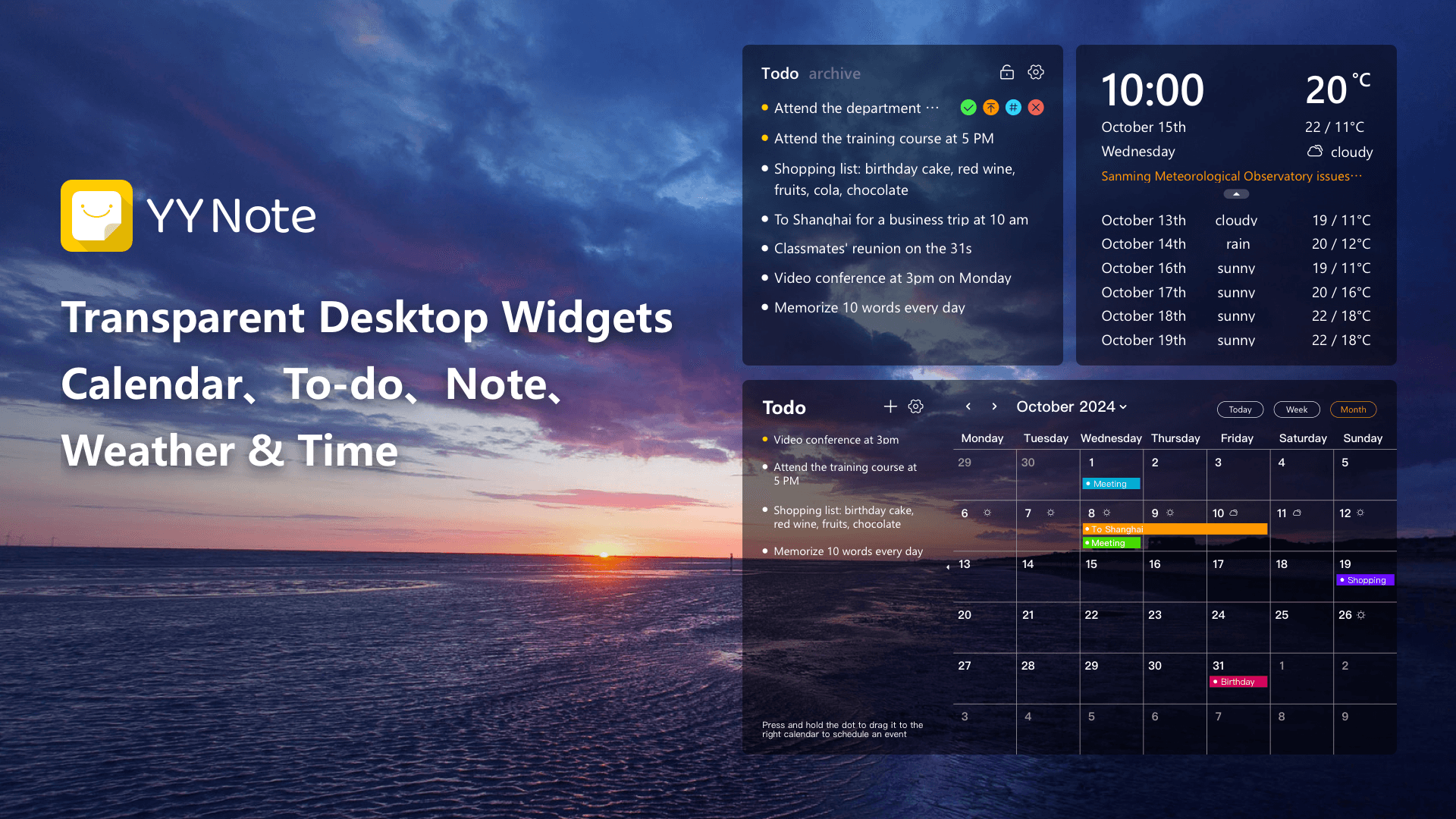
As the focus of this evaluation, YYNote perfectly interprets the efficiency concept of "minimum effort but maximum return". It is not a project management tool with complex features, but an extremely simple and transparent desktop plug-in. Its core setting goal is to achieve the effect of allowing you to see all relevant specific matters at a glance.
Its core to-do list function is embedded directly into the desktop and presented in a fully transparent style. It can coexist harmoniously with any wallpaper without any sense of obstruction. You don't need to open the software extra, all to-do items are clear after booting. For those "Beijing workers" or anyone in the workplace who need to be highly focused, such a "zero-distraction" presentation method can minimize switching costs and allow you to focus on the task itself.
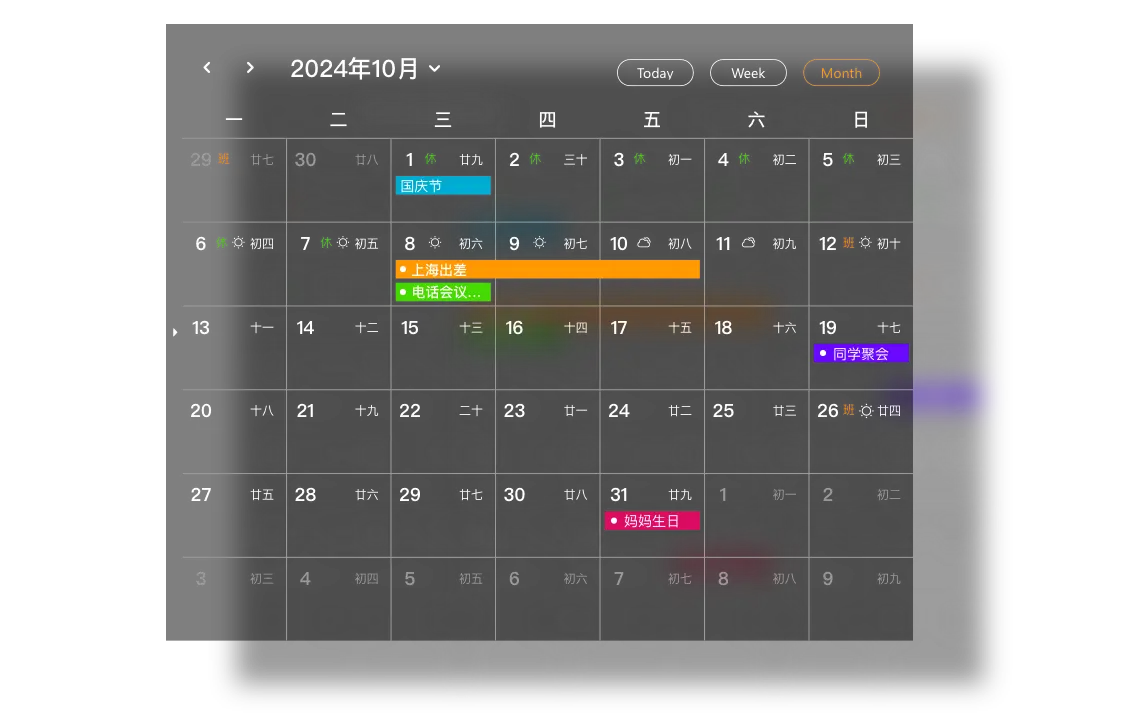
Not only the basic adding behaviors, completing actions and drag-and-drop sorting operations, YYNote has several design highlights that can directly hit the pain points, one of which is. Intelligent recognition and automatic labeling : inputting "meet at ten o'clock tomorrow morning" can automatically determine the time and attach the corresponding label. First, inputting "study at eight o'clock on Friday evening" can automatically determine the date and add relevant labels. Secondly, it can automatically determine the date and add relevant labels. Flexible repeat rules support the function of setting repeats based on the Gregorian calendar and the lunar calendar, so you no longer have to worry about missing your family's lunar birthdays; and this is the third point. The date countdown function adds eye-catching countdown labels to tasks with clear deadlines, such as project submissions or important appointments, and a sense of urgency will naturally arise. All data can support multi-end synchronization and automatic backup, which ensures reliability.
2. TickTick (tick list) ★★★★☆
This task management app is old school and its features are comprehensive. It has a basic to-do list, and also integrates calendar view function, Pomodoro function, habit check-in and other functions. Its ecosystem is complete. Its ability to intelligently recognize dates is excellent, its natural language input ability is also excellent, and its cross-platform support is good.
However, its desktop client, especially for Windows systems, has a slightly weak sense of deep integration. It mostly exists as a separate window and cannot achieve a fully "immersive" desktop transparent embedding effect like YYNote. For those users who pursue ultimate simplicity and expect to-do items to become part of the desktop background, it may feel slightly intrusive.
3. Todoist ★★★★☆
It has a large number of users around the world and is famous for its simple design and powerful natural language processing. After inputting the task sentence, it can parse out the project, label, date and priority with extreme accuracy. The team collaboration function is its strength and is suitable for small teams to share tasks.
Similar to TickTick, Todoist's desktop experience tends to be a carefully designed independent application window, not a system-level desktop component. For individual users, especially those who like complex task decomposition and filters, it is an excellent choice. However, it is slightly less convenient in terms of the convenience achieved by "see it at startup, no operation required".
4. Microsoft To Do ★★★☆☆
If you are an in-depth user of the Microsoft ecosystem, then this free tool has seamless integration with Outlook and Office. It is extremely convenient to create tasks directly from email. Its interface is refreshing and the basic functions are complete, which can fully meet the needs of a short to-do list.
Its limitation is that the functions are relatively basic, and advanced functions such as complex repeat rules and lunar calendar reminders are missing. Its desktop side also lacks deep customization and transparent embedding capabilities. It is more like an ordinary application fixed on the taskbar or start menu. In terms of "visible at any time", it cannot give the kind of intuitive pressure or reminder brought by the previous products.
Summary and action suggestions
After comprehensive comparison, if you are pursuing a non-intrusive, zero-pressure, but always online to-do list and hope that the to-do list can exist naturally like a desktop clock, without interrupting any of your work processes, thereby achieving efficient companionship, then operate in this way to achieve the corresponding effect. YYNote (little yellow bar) is undoubtedly the first object chosen. It reduces the presence of the tool to the minimum, but increases the value of reminders to the maximum. It perfectly fits the core idea of "minimum effort, maximum return".
Imagine that when you turn on the computer every day, those key tasks, approaching deadlines, and recurring schedules are all clearly listed on the desktop. You no longer need to struggle to recall or search for them in the future. Such a calm and unhurried working state is precisely the cornerstone of highly effective people.
Now that you have a to-do reminder on your computer, you can visit the YYNote official website to download and experience this minimalist style desktop efficiency plug-in for free . Spend a minute to install it, and it may open the door to a new way of efficient and orderly work for you. Take action now and make your computer desktop your most efficient personal assistant.
Download Now → Unlock Desktop Efficiency Center:

Microsoft Store

Google Play

App Store