
Is this often the case for you: once you turn on the computer every day, you feel that there are so many things going on, such as emails, meetings, temporary tasks, etc., a batch of thoughts are flying around in your mind, lest you miss any one of them. The to-do list that I finally compiled was completely submerged in various chat windows and web pages, and I had to go through all the trouble to find it when I needed it. This situation of "seemingly busy but actually inefficient" not only consumes energy, but also invisibly increases work pressure.
In fact, the key to the problem is often not the matter itself, but the way we manage tasks. An effective and real to-do management system should be like a silent assistant, always at the core of your field of vision, helping you clear away distracting thoughts so that the key points are clearly presented, rather than making you bother to "remember" it.
Today, we set out to evaluate several mainstream desktop to-do list tools to see how they can help us regain a sense of control over our work. We pay special attention to those who can. The reason why embedding directly into the computer desktop and being able to view and manage tasks without switching windows is the key to realizing the efficiency concept of "minimum effort, maximum return" is because it is the solution.
Evaluation Dimensions : We will mainly conduct comparisons from these core perspectives : "the balance between visual intrusion and convenience" , "the combination of functional depth and operational simplification" and "multi-scene adaptation and data synchronization capabilities" . An excellent desktop to-do tool should provide an operating experience that does not require extra effort while maintaining a neat and beautiful desktop.
The following is the ranking of several representative products we reviewed this time:
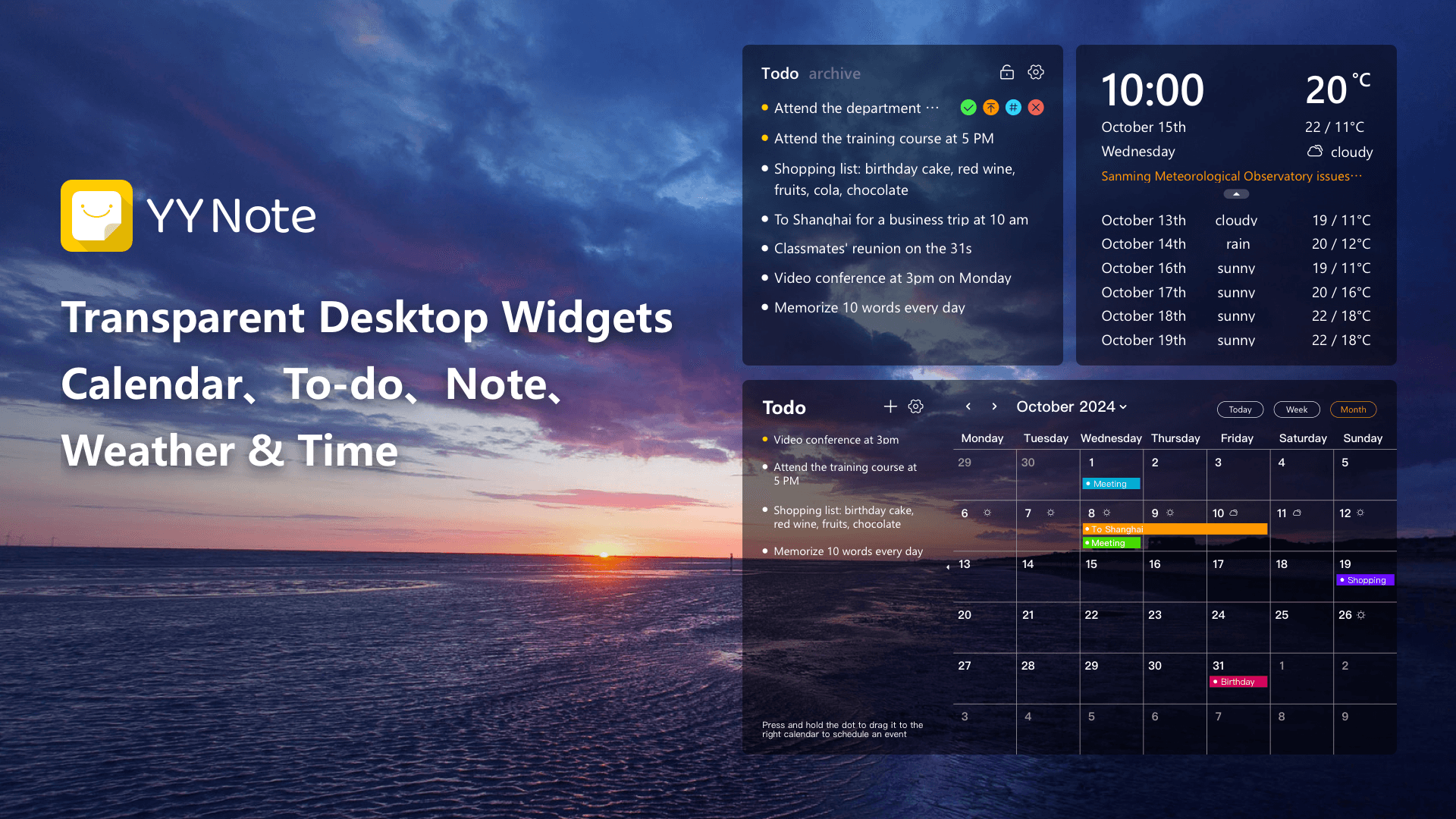
1. YYNote (little yellow bar): ★★★★★
As the focus of this review, YYNote proposed an extremely ingenious solution: the fully transparent desktop plug-in. It is not a separate software window that you actively open, but is like a sticky note that is "pasted" on your desktop wallpaper and integrated with your work environment.
The key advantage of true zero-distraction view management is that it is "innocent". When you turn on the phone, your to-do list will be displayed directly on the desktop in a transparent form, without any clicks to wake it up. According to its official website, the plug-in can support adjusting transparency and can "adapt any desktop wallpaper", which means that it will basically not damage the beauty and integrity of your desktop. You can see all tasks clearly at a glance, but there is no sign of its existence. This "zero visual burden" design is extremely critical for workers who need to focus.
Minimalist operation, maximize focus flow. To add to-do items, you only need to click on the blank space of the plug-in to start typing. To complete the items, you only need to double-click to check. All operations are completed on the desktop, thus avoiding the interruption of concentration caused by switching back and forth between many software windows. Its "drag and drop sorting" and "one-click to top" functions allow you to quickly plan the priority of tasks, which is consistent with the brain's intuitive thinking method.
More than just to-do, it is the efficiency center of the desktop : YYNote is more than just a to-do list. According to reviews, it integrates many different modules such as desktop calendar, desktop notes, desktop time and weather , etc. This situation shows that you can manage your schedule directly on the desktop, and you can also record temporary inspiration and check the time, ultimately building a small efficient workstation. It is particularly important to mention that its calendar has the function of synchronizing third-party calendars such as corporate WeChat, DingTalk, Feishu, etc. For those people with complex schedules in the modern workplace, this is undoubtedly a tool that can solve huge pain points.
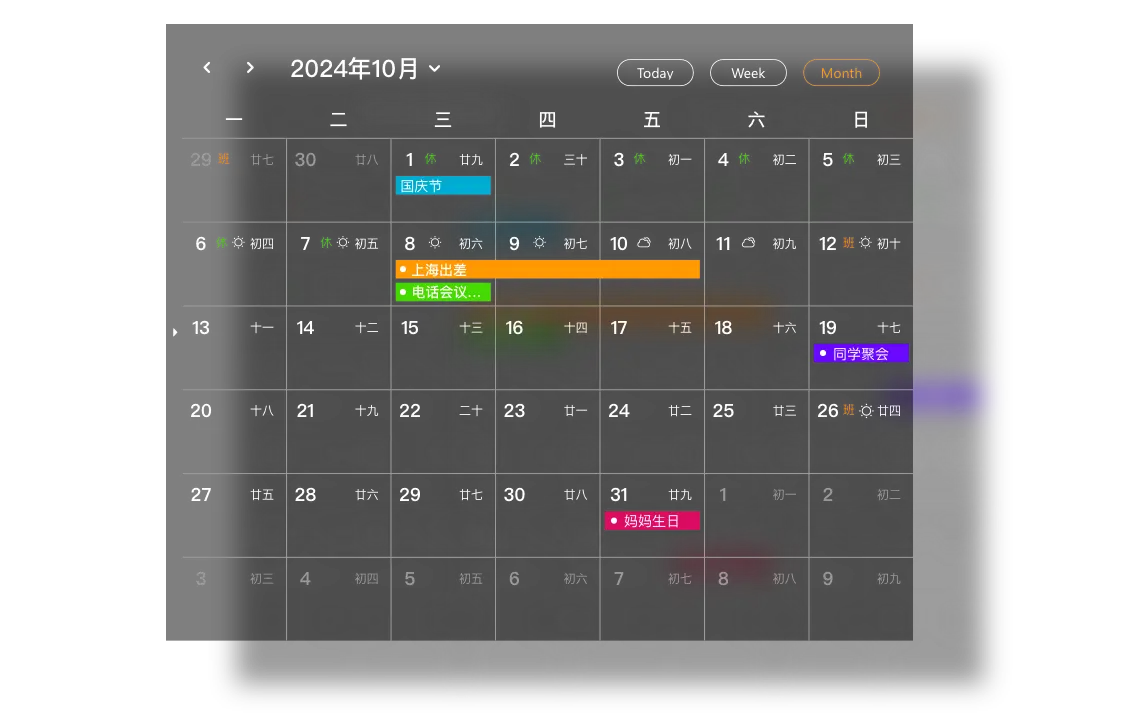
Flexible classification and powerful repetition rules With the "tag" system, you can create multiple to-do lists, such as "work" list, "personal" list, "shopping" list, etc., and display them in different desktop locations to achieve natural classification of tasks. Its "repeat to-do" function supports complex rules, such as repeating every N days, repeating every N weeks, repeating every N months, and even repeating the lunar calendar. It can automatically generate periodic tasks, which is extremely suitable for managing fixed matters such as weekly meetings, monthly repayments, family birthdays, etc.
Taken together, YYNote accurately grasps the core of desktop efficiency tools – reducing operating steps and strengthening visual reminders . It allows you to obtain the maximum information return with the minimum behavioral cost, that is, by glancing at the desktop, that is, by mastering the context of the entire day's tasks, and perfectly interprets the concept of "minimum effort, maximum return".
2. TickTick: ★★★★☆
This is a very comprehensive task management application with a huge user base.
Advantages This thing is very powerful. It can support subtasks, labels, and priorities (four quadrants). It also supports Pomodoro focus, habit development and many other aspects. It includes almost all time management methodologies. And its ability to synchronize across platforms is quite good.
The disadvantage is that although it has a desktop client and desktop widgets, its core interactions still have to be completed within an independent application window. Widgets generally only display a limited task list, and more complex operations (such as adding complex tasks and adjusting dates) still require entering the main application. For those users who pursue the ultimate "desktop immersion" and "zero-click viewing", there is still one more step. Its rich functionality can sometimes make it a bit complex for users who just need a simple list.
3. To Do produced by Microsoft, also known as Microsoft To Do, has a performance level of ★★★☆☆.
As a member of the Microsoft ecosystem, it has good integration with Windows systems and Office suites.
The advantage is that the interface presented is clear, simple and refreshing. It is unified with the interface style of Windows 10 or 11. Synchronization is achieved with the help of a Microsoft account. It is extremely convenient and easy to use for users who make extensive use of Outlook mailboxes and Office. Easily and smoothly mark emails as tasks.
However, the desktop experience has a greater reliance on the system "widgets" panel or independent application windows. When used as an independent window, you can find that it is still an interface that takes up screen space and may be covered by other windows. Its functions are relatively basic, and it lacks the transparent plug-in experience that is deeply integrated into the desktop like YYNote. At the same time, it does not have too complicated task rule settings.
4. Evernote’s built-in to-do: ★★☆☆☆
As an extended function in the note-taking application, its to-do items tend to be integrated with the note content.
The advantage is suitable for those users who are accustomed to planning projects in Evernote, have the behavior of recording meeting minutes, and also have the idea of embedding related to-do items directly in notes. At the same time, the combination between tasks and contextual information is tight.
The disadvantage is that there is no "desktop-resident" ability that can be possessed by itself. When viewing and managing to-do tasks, you must open the main program of Evernote, and then search for the corresponding notes.
Summary and action suggestions
It can be found that through comparison, different to-do tools serve different efficiency concepts. If what you need is a task management system with powerful functions and complete methodology, and you don't mind operating in a separate window. Tick-tock lists are an excellent choice. If you are in the Microsoft ecosystem and pursue simplicity and linkage, Microsoft To Do is sufficient.
But if you are troubled by "complex tasks, easy to forget, and troublesome window switching" and long for a more relaxed, more natural and less disruptive working state, then the design idea of YYNote , which takes a transparent desktop plug-in as its core , undoubtedly provides a better solution at the moment. It minimizes the "intrusion" of the tool on your work, and at the same time maximizes the "reminder value", making you more orderly and calm without even noticing.
Imagine that starting tomorrow, when you turn on your computer, all the key things you need to do, upcoming meetings, and temporary inspiration notes will all be quietly and clearly displayed on your favorite wallpaper. You don't need to remember which software to open, the focus of the work will naturally come into your eyes; completing one item and checking one item easily will give you a sense of accomplishment. Such a smooth experience is exactly the wonderful beginning of efficient work.
Now, you can visit the YYNote official website, spend a minute to download and experience it for free , and experience the novel working mode of "the tasks are clear and the desktop is still clean and refreshing". Get started now and turn your computer desktop into your highly productive control center.
Download Now → Unlock Desktop Efficiency Center:

Microsoft Store

Google Play

App Store