
Have you ever experienced such a situation? That is, there is a long list of things to be done clearly and clearly, but they are lying silently in the corner of the mobile application. If you don't open it, they will be completely forgotten. Or maybe inspiration and meeting points suddenly appeared, and I searched for the note paper in a panic for a long time, but in the end I didn't know which book it was in. When working, your eyes must constantly switch back and forth between multiple specialized software, web pages, and documents. If you don't pay attention to important date reminders, you will be submerged in the complicated flow of information.
These problems may seem trivial, but they actually consume our concentration and efficiency. YYNote (little yellow bar) was created to solve those daily office pain points. It uses a more direct and efficient idea: put the information you need directly on the most conspicuous place on your computer desktop. Now, let’s evaluate several mainstream desktop productivity tools to see how to get the clearest and most organized work returns with the least investment of effort.
First of all, the evaluation meeting will mainly focus on several core dimensions, which are desktop integration, functional practicality, multi-terminal synchronization capabilities and visual interference. Secondly, through actual experience and comparison, I hope it can help you find the one that best suits you.
Ranking list
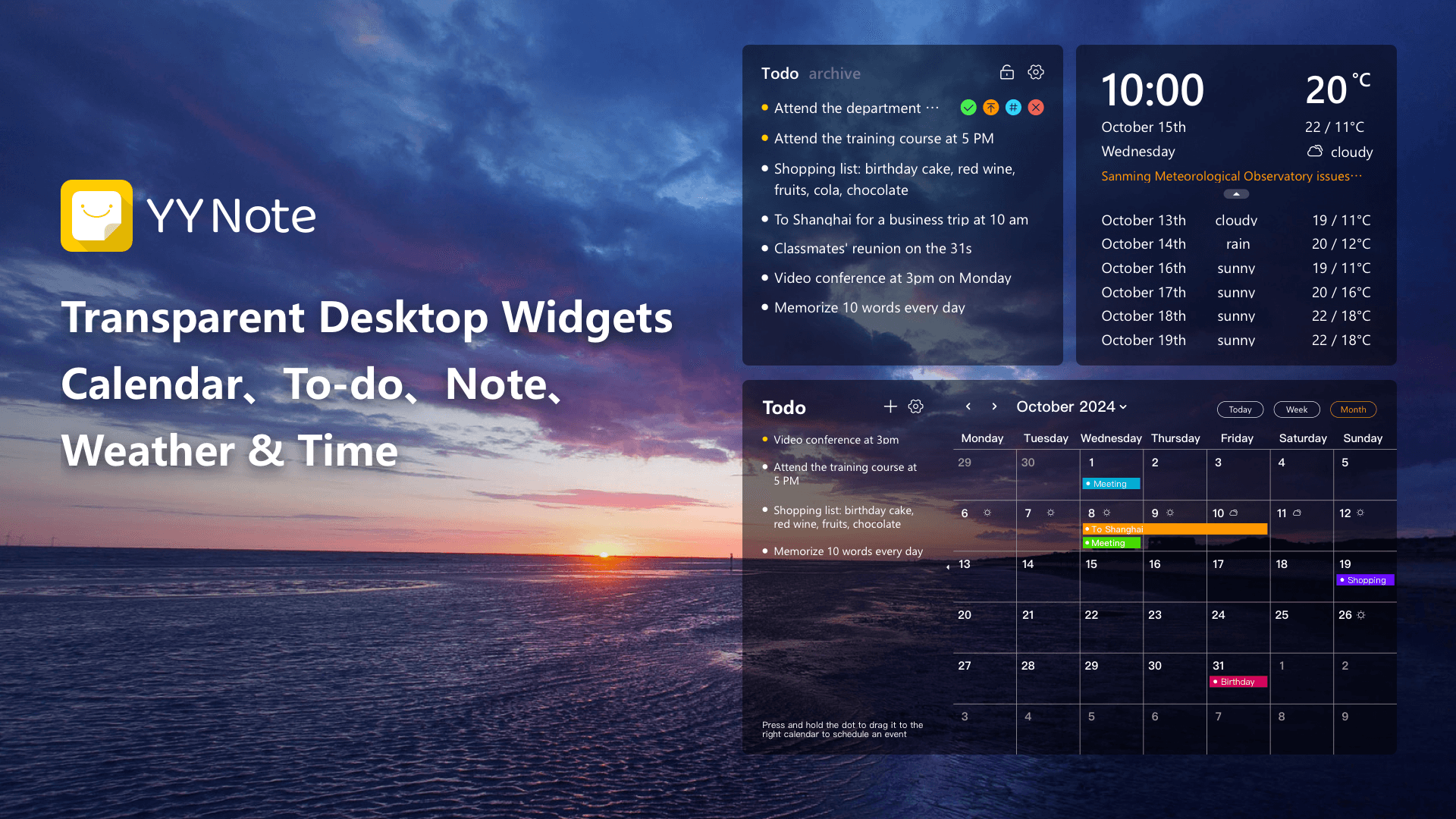
First place: YYNote (little yellow bar) – overall score: ★★★★★
There is a design concept that is very clear and discernible in YYNote, which is to move towards the goal of becoming a member on your desktop. This member should seem to be "no feeling" but "present everywhere", acting as a powerful helper in terms of efficiency. Furthermore, it has a core advantage, which is that it is extremely lightweight and can be deeply integrated with the desktop.
The zero-distraction transparent desktop plug- in itself is a small desktop application that can embed to-do lists, calendars, notes, and weather time directly on your computer desktop wallpaper in the style of transparent plug-ins. This means that you don’t need to open any additional windows. You can see today’s tasks and schedule as soon as you raise your eyes, achieving true “clear at a glance” functionality. There is basically no visual interference, and it perfectly blends into any style of desktop.
Scenario-based functions solve real pain points. Its functional design closely matches the actual workflow. For example, by dragging to-do items onto the calendar, you can quickly plan your schedule. With the help of custom labels, you can automatically classify to-dos and notes. It also supports repeated reminders of the lunar calendar, and is suitable for marking traditional festivals such as family birthdays. These details all show in-depth insights into user habits.
Powerful third-party integration YYNote supports the synchronization of calendars from mainstream office software such as corporate WeChat calendar, DingTalk calendar, Feishu calendar, Outlook (Exchange) calendar, etc. For those users who need to manage multi-platform schedules, it can control all arrangements in one view, avoiding the waste of time caused by switching between multiple platforms for verification.

Multi-terminal coverage and data security It is adapted to the HarmonyOS NEXT system, it is adapted to the Windows system, it is adapted to the Android system, it is adapted to the iOS system, and its data can be synchronized with the help of accounts. As a tool software, it promises to be ad-free, and it also provides a data export function to give users complete control over their information.
After all considerations, YYNote has accurately grasped the key requirement of "desktop visual management" and achieved efficient management of time, tasks and fragmented information in the simplest form, in line with the efficiency concept of "minimum effort, maximum return".
Ranked second is TickTick, whose overall rating is ★★★★☆.
There is an application called Tick List, which is used for task management. It has extremely comprehensive functions and is highly famous among many users at home and abroad.
Rich and powerful functions : From simple to-do lists to complex habit formation, Pomodoro focus, calendar view, etc., it provides a complete set of time management tools. It has functions such as intelligent date recognition and adding tasks in natural language, which is very attractive to users who pursue high efficiency.
Excellent cross-platform experience 1. Covers almost all mainstream platforms, and the synchronization is stable. 2. Its UI design presents a clear state. 3. After years of polishing, the interaction logic appears relatively mature.
The difference from YYNote is that it is an application or web page that needs to be opened automatically, rather than a permanent plug-in on the desktop. Although some platforms, such as Windows, also support desktop widgets, their depth and integration with the system desktop are usually not as good as YYNote. For those users who expect information to be "passively presented" rather than "actively queried", there may be one more operation. Its rich functions also mean that there is a certain learning cost, and it is more suitable for users who are keen on in-depth planning and time management.
The third place is Bing Notes, which has an overall rating of three and a half stars.
Here we fictionalize a lightweight tool called "Bing Notes", which represents another category of choices, the kind of basic tool that is deeply tied to the operating system or a large ecosystem.
Convenience and low threshold are usually provided as a system's own application or as part of a large software suite. For example, it is similar to the note component in some office suites. There is no need to download and install additionally, and it can be used after opening it. It is very convenient for users who only need basic text recording functions.
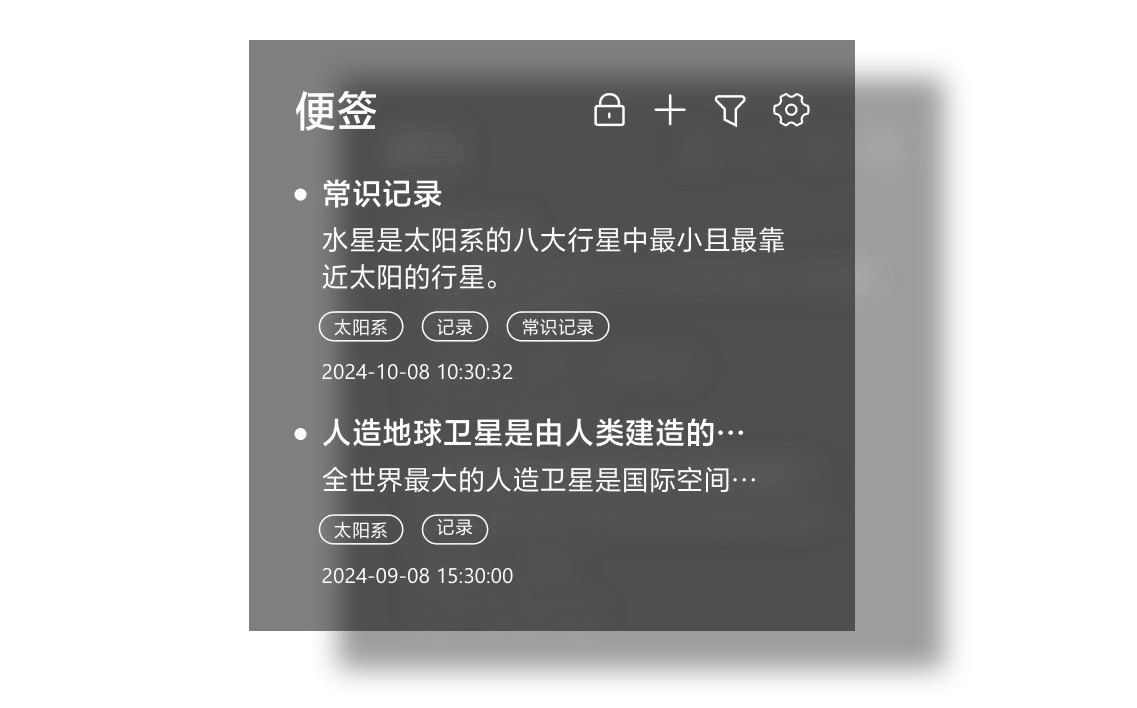
The function is relatively simple , mainly to quickly record text information, and may have a simple list function and cloud synchronization. However, it usually lacks the complete and complete calendar view, fine management of to-do items (such as tags, repeat rules, drag-and-drop planning) and the ability to integrate with third-party calendars like YYNote.
Ecosystems limit their experience and synchronization capabilities, and are highly dependent on the ecosystem to which they belong. For example, specific operating systems or account systems may lack flexibility across platforms and ecosystems. At the same time, desktop resident display capabilities vary from system to system and may not be as powerful as specially designed desktop plug-ins.
Ranked fourth is SparkCard, which has an overall rating of three and a half stars.
Suppose we make up another fictional application. The name of this application is "Think Cards". It has probably the most important main direction, which is to focus on the capture of inspiration and the management of knowledge.
Tools such as creativity and information management perform well in handling more complex notes, web clippings, and multi-format content collections. Their functions are more similar to lightweight note-taking software in nature, and can assist users who need to organize large amounts of data, write long articles, or conduct knowledge research.
The key to positioning difference lies in "collection" and "organizing" rather than "reminding" and "execution". Although there may be a to-do function, this is not its most prominent strength. If you use this type of tool as a daily work plan management, you may feel that the structure is not clear enough, the reminder is not obvious enough, and it cannot give a strong sense of task drive like YYNote or tick list.
The desktop presence is weak. It usually exists in the form of a complete application window or a browser plug-in. There are relatively few transparent widgets that are deeply embedded in the desktop, so it is impossible to achieve the "always in front of you" reminder effect.
Choosing work planning software is actually choosing a way to manage your attention and time. If you are tired of shuttling back and forth among complicated functions and want a relaxed, stress-free working environment where you can clearly control the entire situation at all times, then place key information directly in the desktop view. YYNote undoubtedly provides an efficient path.
It reduces the time you spend on the "management tool" itself to a minimum, but puts the most energy into real work and life. You might as well visit the YYNote official website now, download and experience this exquisitely designed desktop efficiency plug-in, and start a more orderly and leisurely work mode. You will find that managing every day can actually be very simple.
Download Now → Unlock Desktop Efficiency Center:

Microsoft Store

Google Play

App Store