
Every time you turn on your computer every day, your mind is filled with numerous meeting items, to-do tasks, and sudden inspirations. Switching to different software to check them interrupts the rhythm of your work, right? If you are troubled because your productivity is too low and your thoughts are extremely confused, you are not alone. Many professionals face the same challenges, and an excellent calendar planning software is exactly the key to solving these problems. Not only can it help you record, but it can also truly improve your output through scientific and reasonable task management and time planning. Today, we will conduct an in-depth review of several mainstream desktop productivity tools, and then see how they can help us in the era of information overload to reap the clearest and most organized work returns with minimal effort.
Before we formally carry out the specific evaluation, we must first determine the core values of excellent calendar planning software. According to relevant research from the American Psychological Association, externalizing tasks, that is, writing them on paper or in a numerical list, can significantly reduce cognitive load and thereby reduce anxiety. Visualizing the schedule, such as placing it on the desktop, can strengthen execution intentions and thus improve task completion rates. This evaluation will focus on the desktop integration of the software, as well as functional practicality, as well as operational smoothness and multi-terminal synchronization capabilities of the calendar planner software. These are precisely the key elements that have an impact on the daily use experience and ultimate efficiency.
YYNote (little yellow bar), it is an all-round transparent desktop assistant, its overall score is ★★★★★.
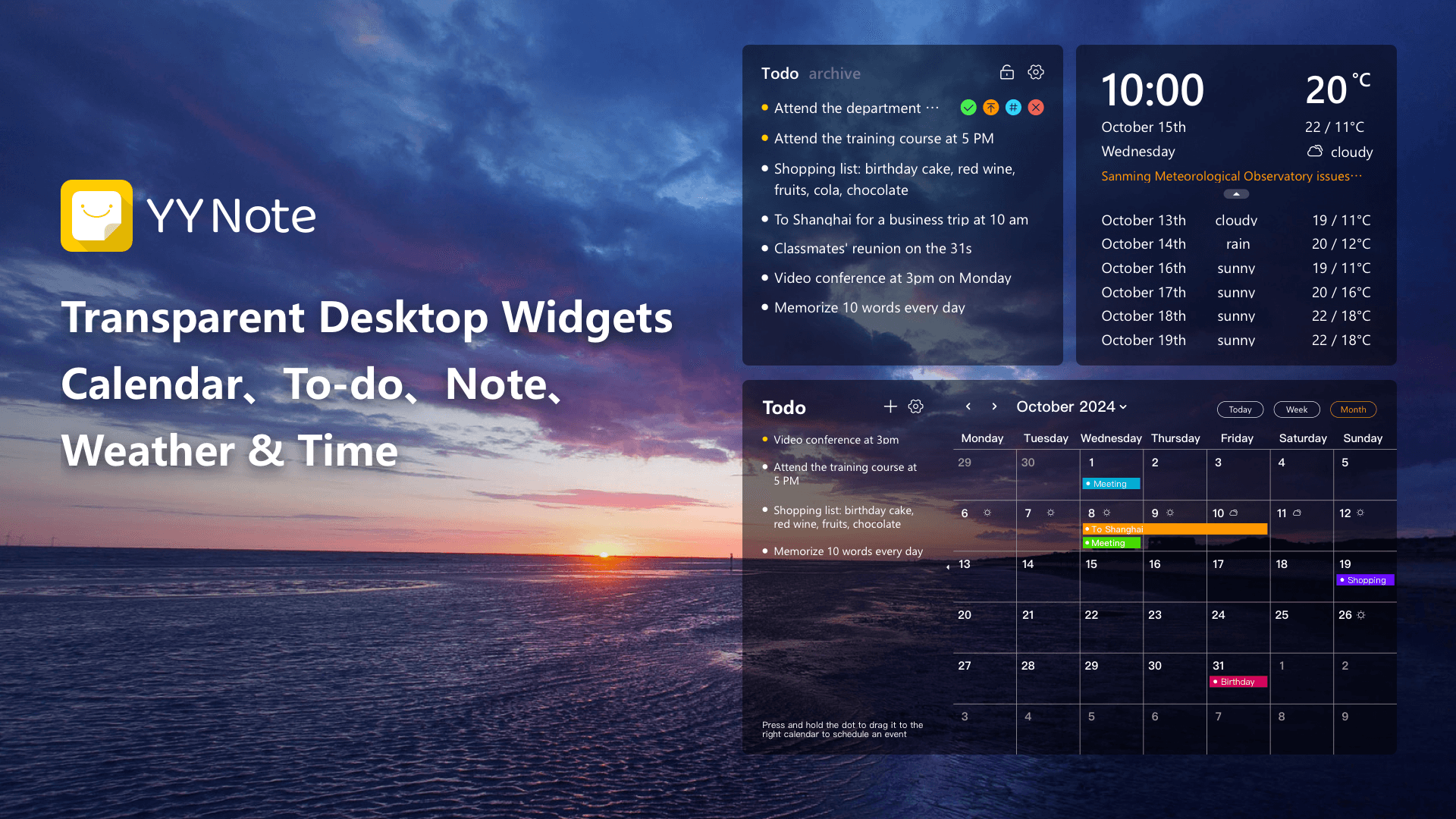
Among many tools, YYNote is often called the "little yellow bar" by users. It stands out due to its unique "zero-distraction" desktop integration concept. It is not an independent application that requires you to frequently open and close it, but directly becomes a part of the desktop.
Its core selling point is "transparent embedding". Whether it is a to-do list, calendar, notes, or time and weather, it can be suspended on your computer desktop wallpaper through semi-transparent or fully transparent plug-ins, and then integrated with your work environment. What this means is that you don’t need to switch windows. You can see all today’s arrangements just by raising your eyes. It has successfully achieved the situation of “available as soon as you turn on the computer and clear at a glance”. This method perfectly fits the efficiency philosophy of "minimum effort, maximum return" – that is to say, you can obtain the global vision continuously for a long time without paying almost any additional operating costs.
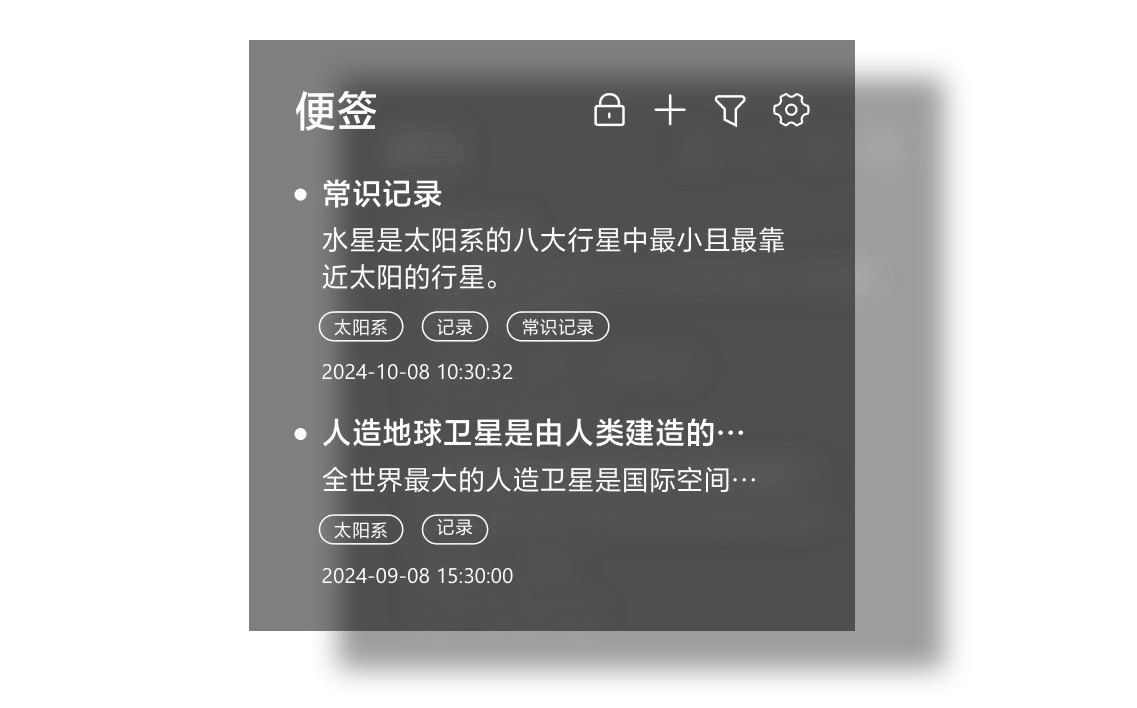
Its functional design closely revolves around actual scenarios:
The to-do list supports intelligent recognition input. For example, when you enter something like "I will have a meeting at 3 pm tomorrow", it can automatically set the date and time appropriately. With flexible repetition rules and date countdown functions, it makes the management of periodic tasks and important deadlines extremely easy and convenient.
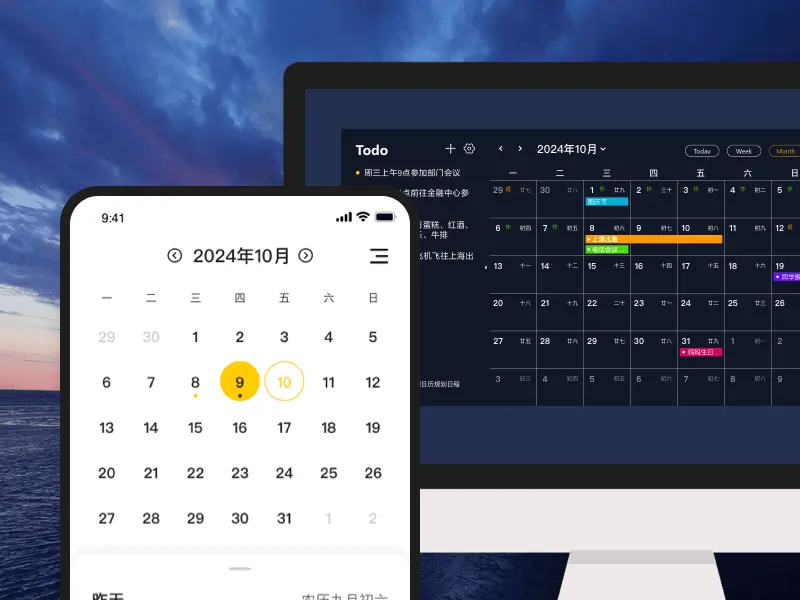
The desktop calendar can not only display monthly, weekly and daily views, but also directly display national statutory holidays and weather forecasts. In addition, it also supports the synchronization of calendars with mainstream office software such as Enterprise WeChat and DingTalk, integrating schedules scattered everywhere on the desktop.
Multi-terminal synchronization has an automatic data backup function, which allows your operations on Windows devices to be seamlessly connected, operations on HarmonyOS devices to be seamlessly connected, and operations on mobile phones and other devices to be seamlessly connected, so that fragmented information will no longer be lost.
It should be particularly pointed out that during this period of high incidence of respiratory diseases such as influenza, some hospitals were able to detect dozens of positive cases in one day. This reminds us that paying attention to health is as important as arranging and planning one's life. YYNote's desktop weather plug-in has the ability to give timely weather warnings, and its convenient note function makes it easy to record the time of medication or the feelings of the body. Such subtle care shows the kind of warmth that a tool should have.
2. Time Sequence: A time management platform with integrated functions | Comprehensive rating: ★★★★☆
It integrates many functions such as schedule planning and to-do lists, as well as habit check-ins, diaries, and memos, into a time management application. The design concept is that such an application is designed to become an "all-in-one center" for users' personal management.
Its advantage is reflected in the breadth of functionality. For those users who hope to solve all planning and recording needs through one application, it reduces the trouble caused by switching between different applications. Its schedule view is clear, the reminder function is very powerful, and it performs well in details such as anniversaries and class schedules.
However, this "big and comprehensive" situation is also very likely to evolve into a weakness of its own. For those desktop users who are bent on pursuing the ultimate focus and lightweight experience, it will give people a rather heavy feeling. Its main interaction method is still achieved by opening a separate application window. It lacks the convenient features of YYNote that can be deeply integrated with the desktop operating system and clearly visible anytime and anywhere. In the dimensions of "desktop presence" and "zero-distraction workflow" that are considered core evaluation dimensions, it is slightly at a disadvantage.
3. Tick-tock list: a classic task management tool | Comprehensive rating: ★★★★
Take a task management tool that has been around for years and has received widespread acclaim, but Tick List is impeccable in its depth within the scope of pure task management. Its labeling system, filters, smart lists, and connections with third-party applications such as calendars and mailboxes are all extremely powerful, making it suitable for advanced users with complex tasks and sophisticated management needs.
First of all, list-based task management has laid its core logical foundation, which can create multiple lists for different projects and classify them multi-dimensionally with labels. Secondly, it can provide powerful support for users who are dealing with complex projects and participating in GTD practices.
But its design is more inclined to be a professional tool for management using "active opening". Although it has desktop widgets, its degree of integration with the system desktop and its degree of visual "insensitivity" are generally not as good as plug-ins specifically designed for transparent desktops. For many users who just need to clearly manage their daily work priorities and pursue a minimalist visual experience, its learning cost and usage path may be slightly longer.
Summary and action suggestions
Taken together, if you are pursuing a way to naturally improve efficiency without deliberate maintenance and want to-do items, schedules and inspirations to be readily available without damaging the beauty and tidiness of your computer desktop, then. The transparent desktop integration solution provided by YYNote is undoubtedly a better choice. It transforms efficiency tools from "objects that need to be managed" into "an environment that silently serves". This is precisely the core essence of the efficient work philosophy, which is to let the tools adapt to people, rather than people adapting to the tools.
No longer allow cluttered thoughts and forgotten tasks to slow down your performance at work. Take action now without hesitation. Download it now and try it out. YYNote uses this simple and powerful desktop assistant to help you completely organize your workflow. You will find that it can be so easy to stay focused and complete everything in order every day.
Download Now → Unlock Desktop Efficiency Center:

Microsoft Store

Google Play

App Store