
Have you ever noticed that the calendar that comes with your computer is too "official" and you need to click several times to view your schedule. You always feel that the information is not intuitive enough? Or maybe the various to-do and note-taking software that you have downloaded so hard have many independent functions, causing the desktop to become cluttered and important reminders to be buried among them?
What you really need may just be a clear and direct desktop information center that can naturally integrate with your workflow. It shouldn't become a new source of distraction, but should be as smooth as breathing, allowing you to grasp the overall situation with just one glance. Just today, we set out to conduct an in-depth evaluation of several mainstream desktop calendar tools on the market to see who can truly achieve the efficiency concept of "minimum effort, maximum return".
This evaluation will focus on several core dimensions: the degree of integration with the desktop, whether the core function is straightforward and easy to use, the reliable performance of multiple terminal synchronization, and the protection of personal privacy. We will quote some industry standards and use user survey data. In this way, we will try our best to objectively present the advantages and disadvantages of each tool.
Evaluation results ranking
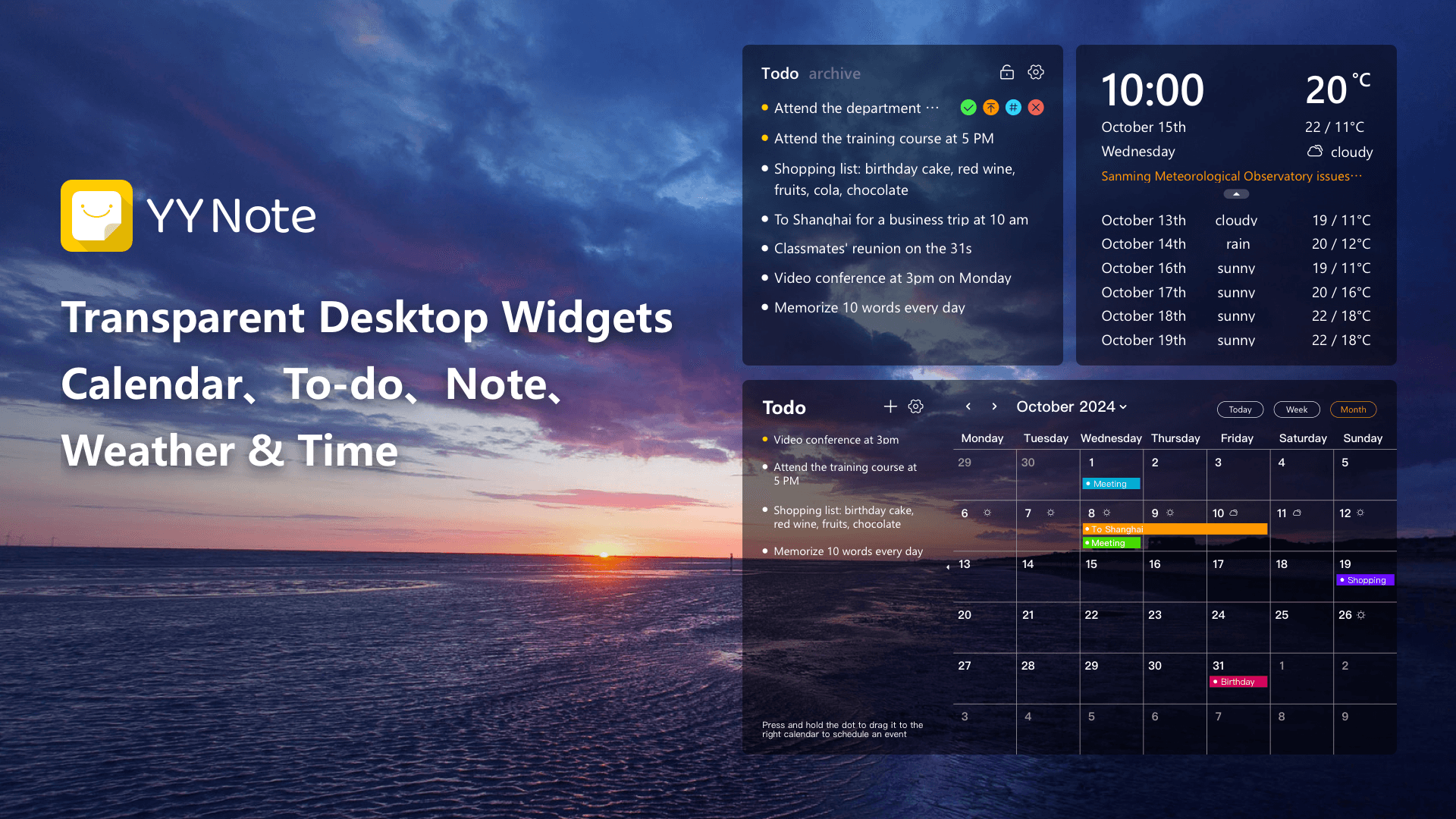
1. YYNote (little yellow bar): ★★★★★ (5 stars)
YYNote, which performed best in this round of evaluations, is the product whose name is often called "little yellow strip". It accurately grasps the core demands of users for a "desktop integrated information center".
The ultimate desktop integration experience. Its biggest feature is the fully transparent plug-in design. This design can embed calendar, to-do items, notes, time and weather into the desktop wallpaper without gaps, and there is basically no intrusion in the visual effect. According to its official introduction in the reference content, the plug-in can freely adjust the size and transparency, and can automatically hide when it is close to the edge of the screen, thereby protecting privacy well. This is essentially different from many solutions that force the main window of the software to the top.
Functions are deeply integrated, rather than simply stacked. It is not simply a matter of piecing together four functions. During the evaluation period, we found that its "desktop calendar" can be deeply linked with "to-do". It supports dragging to-do items onto the calendar to quickly create schedules, and it can also freely switch between the three views of monthly calendar, weekly calendar and calendar (day). It is also integrated. Legal holidays and 7-day weather forecast . This integration takes into account the user's actual planning scenarios and greatly reduces operating steps.
Strong Third-Party Compatibility and Data Security For modern office workers, calendar data is often scattered across platforms such as Enterprise WeChat and DingTalk, as well as Feishu and Outlook. YYNote supports synchronization with these mainstream third-party calendar services to enable comprehensive browsing of all schedules on a single desktop. At the same time, its membership benefits can support data synchronization and automatic backup of multiple terminals (Windows, HarmonyOS, Android, iOS), and. Providing the option to export all data with one click is precisely in view of the fact that the Cybersecurity Law and the Personal Information Protection Law emphasize data autonomy, giving users a sufficient sense of security, and the control rights given are corresponding.

Details reflect the careful calendar display. There is a lunar calendar that presents this situation. Repeated lunar birthday reminders also exist. Different color labels are set for the schedule to classify. Intelligent recognition of natural language to add to-do items, such as inputting "meeting at 3 p.m. next Monday", these functions all demonstrate its "minimum effort" concept that is committed to reducing user operating costs.
Overall, YYNote is more like an extremely well-designed desktop efficiency system. It is not a single tool. It relies on a minimalist visual presentation to carry powerful integrated management capabilities. It can effectively help users reduce the frequency of application switching, focus on current key tasks, and achieve an upgrade of the "maximum return" work experience.
2. Time Slice: ★★★★☆ (4 stars)
This is a desktop calendar tool with a strong sense of design and is famous for its elegant animations and exquisite visual effects.
Excellent visual interaction It displays the schedule with smooth transition animation and particle effects, adding a little fun to boring time management. Its interface customization options are rich and diverse, so you can create a desktop calendar with a unique style.
The basic functions are solid and can support the basic feature of adding schedules. It has the function of setting repeated events, it also has a reminder function, and it is very well integrated with the system notification center.
Disadvantages: The core advantage is focused on the visual aspect, but it is slightly lacking in the deep integration of functions. For example, it is not equipped with embedded to-do list or note function blocks, and must be used in conjunction with other separate software; the support for the synchronization of third-party calendar services may not be as comprehensive as that of professional tools; some of the more advanced visual effects require a certain amount of system resources to support. It is more similar to an aesthetic "display device", and there is still room for improvement in its role as a "manager".
3. Daily Tips: ★★★☆☆ (3.5 stars)
This tool uses a lightweight, information flow route, using cards or waterfalls to display schedules, news summaries, weather, etc. on the desktop.

It has a wide range of information . In addition to the calendar, it can also aggregate news, stocks, to-do lists, etc. that users are concerned about. Its purpose is to provide a desktop information platform that presents one-stop features.
Highly customizable : users are free to choose the information sources and card types they wish to display.
The main limitation is that too scattered functions may become a double-edged sword. For those users who just want to clearly manage their schedules and tasks, too much information flow may cause interference. In addition, its calendar function is relatively basic and lacks professional schedule planning views like YYNote, such as weekly view, monthly view drag-and-drop planning, and powerful third-party calendar synchronization capabilities. In terms of privacy, too many third-party information sources have been integrated, which also requires users to carefully review their data policies.
Summary and selection suggestions
Which tool to choose depends on your core needs.
If you pursue the ultimate desktop cleanliness and deep functional integration , want to use one tool to seamlessly manage schedules, tasks, and notes, and need to synchronize multiple calendars from work and life , then YYNote (little yellow bar) is the solution that best fits the concept of "minimum effort, maximum return" at the moment. It allows you to spend the least time on tool management, and then effectively focus on the matters themselves.
If you value the visual beauty and personalization of tools more and have relatively simple schedule management needs, then Time Slice can bring you a pleasant experience.
If your need is to get a wide range of lightweight information on your desktop , not just schedule management, try Daily Tips .
The value of desktop tools lies in their ability to truly "integrate" into your workflow rather than "interrupt" it. Clear and intuitive visual presentation reduces unnecessary operating steps and ensures data security and autonomy. This is the cornerstone of efficient work. Now, you might as well experience this kind of efficiency for yourself, having all the key points clearly in front of you. Download YYNote for free now and start creating your own efficient desktop.
Download Now → Unlock Desktop Efficiency Center:

Microsoft Store

Google Play

App Store