
Have you ever had such a moment, your fingers were hovering over the keyboard, but your mind was completely blank at that time. That beginning of the project, that all-important email, that long-gestating writing project, and so many other projects like this… we struggle with all kinds of "starting steps" every day. I clearly know in my heart that the matter is extremely important, but I am always held back by an invisible resistance, and I am never able to take that crucial first step. I will not stop until it has become an "urgent key point" that needs to be dealt with urgently.
Almost everyone in the workplace has this common problem. We have tried various methods, such as writing to-do items on Post-it notes and then covering the borders of the monitor. We also downloaded extremely complex schedule management applications on our mobile phones to set priorities, sub-tasks and countless reminders for tasks. However, these tools themselves often become a new burden. Adding all the details to a task is a headache in itself. In the end, these tools often become "emergency recorders", which means that we are forced to use them only when things are so overwhelming that they are about to get out of control.
If planning itself becomes an obstacle, then perhaps what we need is not a more sophisticated tool, but one that understands us and helps us. The first step to dismantle your partner is precisely the evolution trend of modern efficiency tools, from a recording device without warmth to a proactive and intelligent assistant.

Just imagine, you don't need to learn any complicated rules, you can just "speak" your inner thoughts in the most natural language. It's like if you typed "I plan to start working out and move toward boxing, but I don't know where to start." A real smart assistant will not just hand you a to-do list like "arrange boxing lessons." Like an experienced coach, it will immediately help you break down this vague idea into clear and implementable steps: first, spend half an hour on the Internet to find a local boxing gym and browse relevant reviews; second, call the three shortlisted venues tomorrow afternoon to inquire about courses and prices; third, go to one of them for an on-site inspection on the weekend.
Understanding is the core of the philosophy of efficiency. It understands that what stands in our way is not the huge number of tasks themselves, but the state of confusion that arises when we start taking action. It will break down the grand goals into small things that can be started right now without putting too much energy into it, thereby building the first and most critical steps for you. When given a clear instruction like “Call Venue A,” the obstacles to taking action magically disappear.
This kind of intelligence is not limited to decomposition. It can automatically plan your schedule according to the severity and urgency of your tasks. You only need to be responsible for "proposing ideas". It will comprehensively consider all your to-do items, just like a personal secretary, and arrange important and urgent tasks in the morning period when you are full of energy, and arrange fitness and reading tasks in appropriate intervals. It even has the ability to learn your habits. If you have told it that "cats often disturb work in the afternoon" desktop schedule tool, then when it plans a writing task that requires deep concentration for you, it may thoughtfully include "try to find a quiet cafe" in the sub-item.

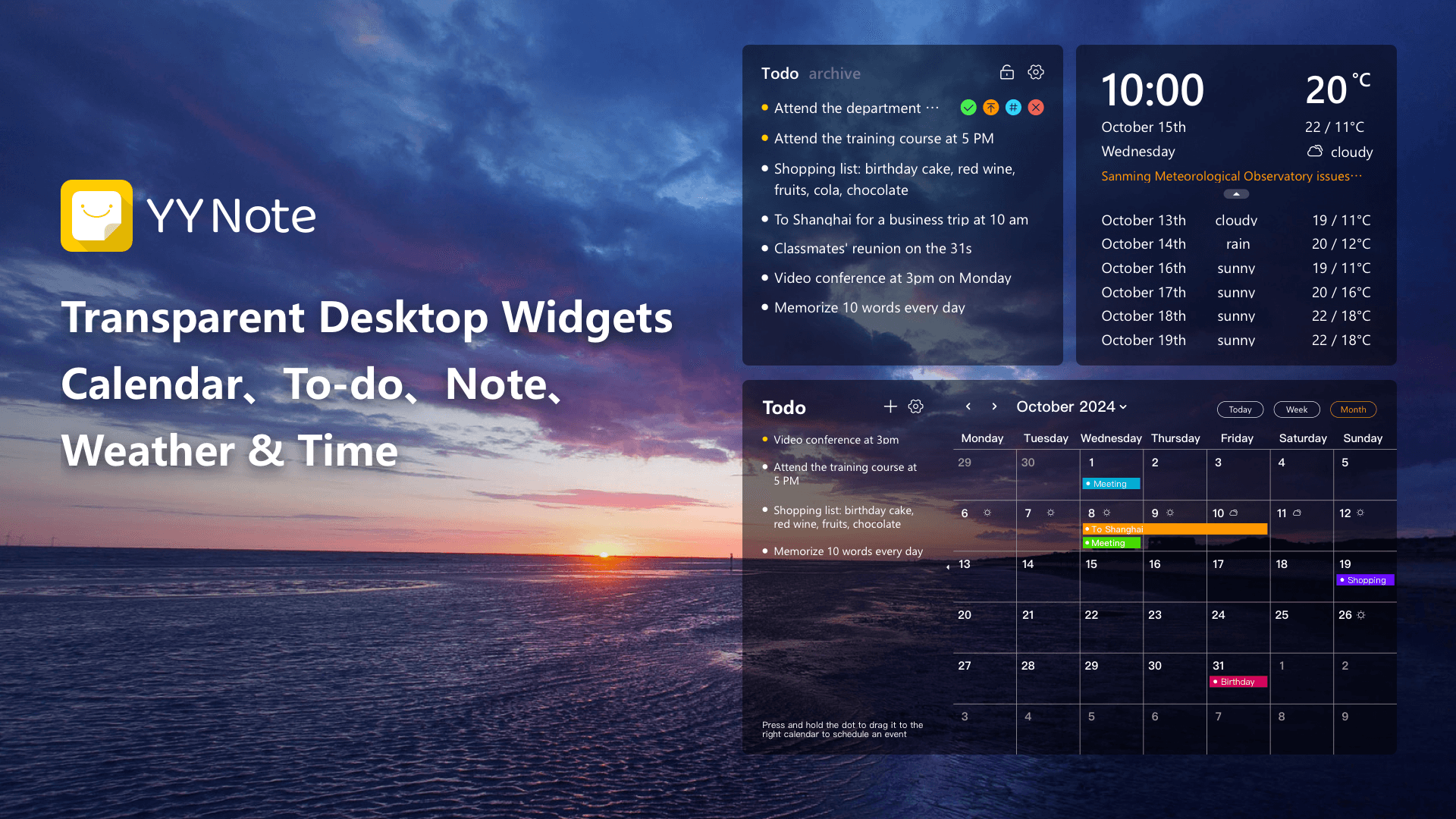
YYNote has such a design, which is based on the concept of "minimum effort, maximum return". It abandons complicated settings, allowing you to focus on the things themselves. Whether you need to record an inspiration that disappears in an instant, or plan a week's project nodes, or just want to sort out the first three things today, it is presented on your desktop in the most intuitive way. It is clearly visible and can be seen when you turn on the computer. There is no need to click to open any application, making planning itself a senseless and relaxing background behavior.
The true meaning of efficiency is never to force oneself to evolve into an almost strict machine that must follow a plan, but to use the smartest method to remove obstacles on the path of action. When tools master the ability to think and take on the tedious and energy-consuming parts of planning, we can devote all the saved mental resources to creation and thinking in the true sense.
From now on, say goodbye to the repeated entanglement of "everything is difficult at the beginning". You only need to start thinking, and it assumes the responsibility of helping you turn your thinking into practical actions. Click the link below to experience it immediately. YYNote allows you to start every day's work clearly and calmly.
Download Now → Unlock Desktop Efficiency Center:

Microsoft Store

Google Play

App Store