
Have you ever encountered this situation: when you are processing emails in front of the computer, you suddenly remember that there is an important meeting tomorrow that requires preparation of materials, and you quickly write it down on the note; you suddenly see the deadline reminder of another project, and you set an alarm clock on your mobile phone in a panic; just when you are about to take a breath, the thought of "submit your weekly report before 4 p.m." flashes in your mind. To-do items in work and life are like snowflakes, scattered everywhere – paper notes are stuck all over the border of the monitor, the entries in the memo on the mobile phone are messy, and there is always an uneasy feeling in my heart: "Have I forgotten something?" Such a fragmented record format will not only consume energy, but also make it easier for things of truly important nature to be missed in a state of confusion.
At this time, what you need is a to-do list system that can always be in front of you and have a clear view. An ideal desktop to-do tool. It is not just for simple recording. It can help you achieve several key changes, from relying on your own brain to remember. Let the tool bear the memory pressure ; from "rummaging around" to grasping the overall situation at a glance ; from "passive reminder" to active planning and sorting. The key value is that with the smallest operating cost, you can gain the highest degree of control over the task, thus freeing up that precious concentration.
Make to-do items clear at a glance: the core value of desktop lists
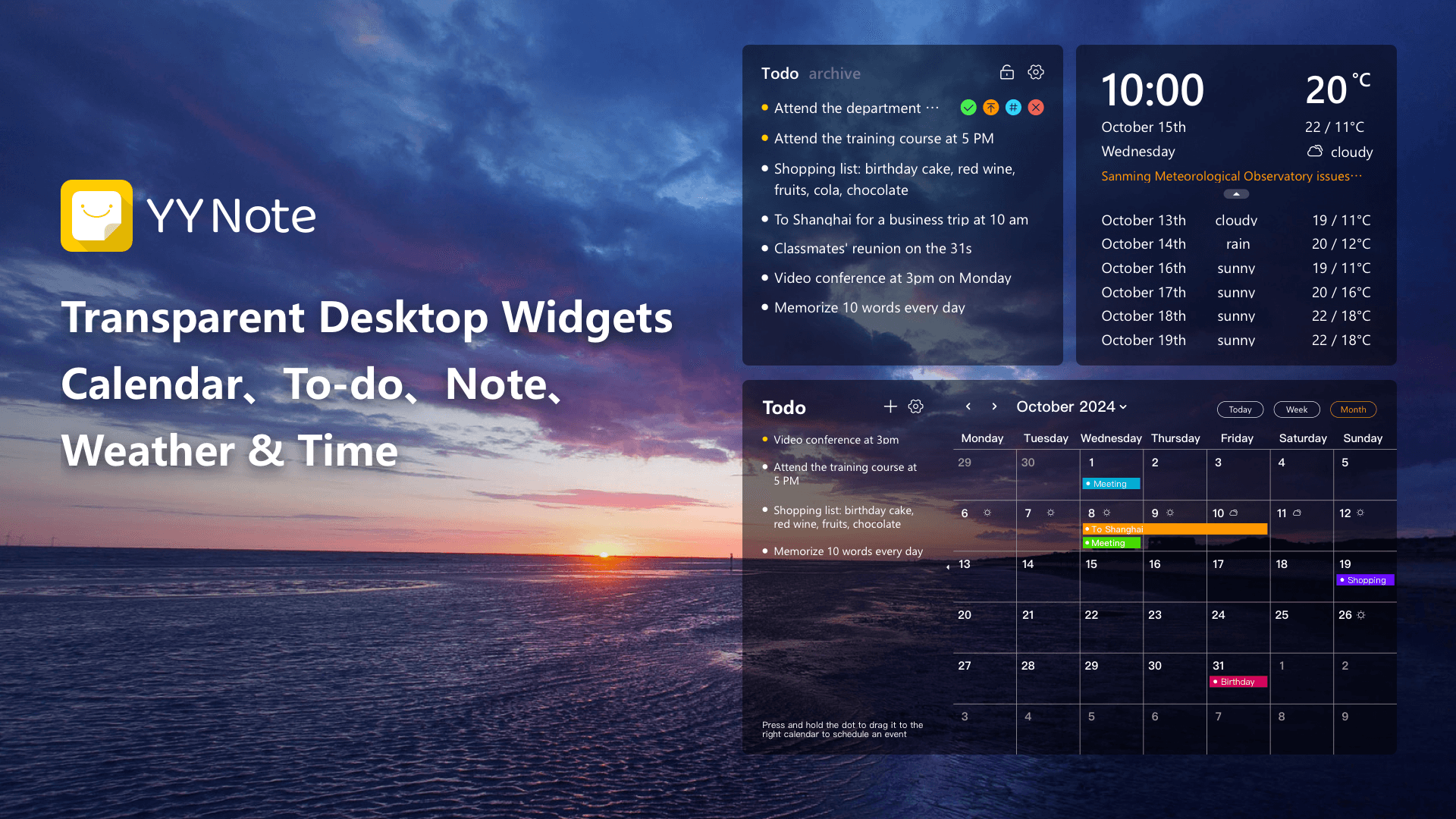
The biggest advantage of pinning to-do items on your computer desktop is to establish a visual reminder system that you don’t need to search for. Whether you are writing a report, looking for information, or browsing the web, your task list is always within your field of vision. This is a seemingly quiet but extremely efficient way of urging. It can effectively combat the procrastination problem of "if you don't see it with your eyes, you won't think about it in your heart." The reason is that you cannot easily choose to ignore those unfinished projects.
To achieve this goal, a good desktop to-do tool will generally have several key features:
There is such a list of resident desktop and smart hiding . It can be embedded in the desktop wallpaper in a transparent or translucent style without blocking the core work area. When needed, it can be quickly called up at any time. When not needed, such as a full-screen presentation, it can be hidden through one-click operation or automatic hiding to protect privacy.
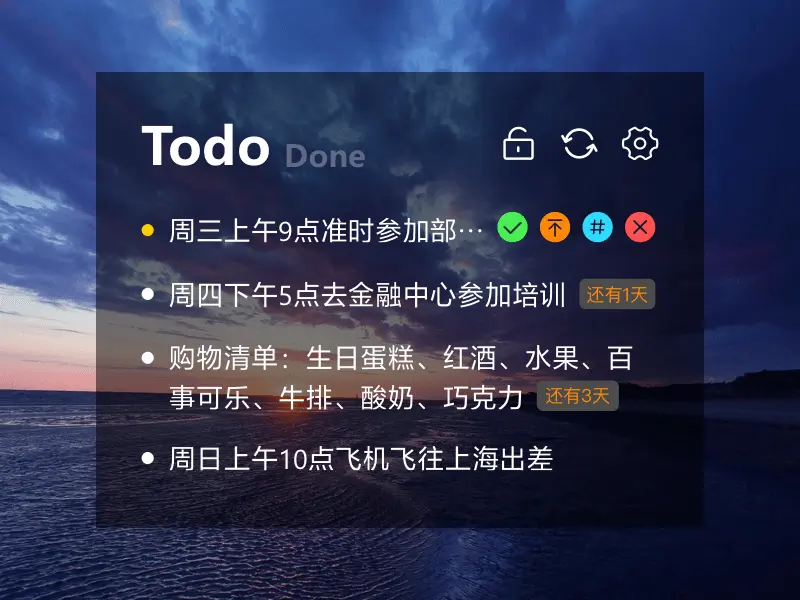
Minimalist and fast operation. Adding tasks should be as natural as breathing. The ideal thing is to support waking up with shortcut keys, or creating them by dragging, or using voice input. Operations such as modification, completion, and postponement should also be completed in one step as much as possible.
Clear task management allows you to easily categorize tasks, label them, set priorities or determine deadlines. Seeing to-do groups like "Today/This Week/Important" gives you more power to move forward than facing a long unordered list.
From recording to planning: Make your to-do list more efficient
A to-do system with efficient features can help you move from a passive "recorder" to a proactive "planner". This assistance is reflected in some functions presented in a more intelligent category. These functions that can handle complex situations will make you more calm.
Coping with repetitive tasks calmly For periodic tasks such as holding a weekly meeting, paying off every month, and sending birthday greetings every year, there is no need to rely on manual labor to add them repeatedly. The system can automatically create new to-do items for you before they are due based on the flexible rules you set, such as every N days, every N weeks, every N and every year according to the lunar calendar. This ensures that no routine is forgotten due to carelessness.
Control important nodes: If the date countdown function is a project milestone, or an exam date, or an important anniversary, it may not be enough to just remind you that "you must do something that needs to be done on a certain day." You can use the date countdown function to mark these key target days, and it can also dynamically display "X days left". Such a visual sense of imminence can help you plan your preliminary preparations reasonably, thereby avoiding the situation of being overwhelmed at the last minute.
Simplify the complex: an advanced to-do tool with intelligent recognition and automatic classification capabilities, and the ability to understand your natural language. When you enter "meeting with clients at 2pm next Wednesday", it can automatically identify the date and time, and then set a reminder for you. By combining with the labeling system, it divides tasks such as "computer repair" and "purchasing stationery" into the "administrative chores" category according to preset rules to maintain the clarity of the list.
Start on the desktop, not stop at the desktop
For modern people, tasks may come from chat messages on mobile phones, emails on computers, or inspiration that suddenly appears. Therefore, the ability to synchronize to-do items is critical. Ideas you come up with while commuting on your mobile phone can be instantly synchronized to your computer desktop list; tasks planned in front of your computer can also be viewed and completed on your mobile phone at any time. This seamless connection ensures that the task management process will not be broken.
The ultimate purpose of efficient desktop to-do is not to manage the tasks themselves, but to manage your attention, time and life. When chores are managed by the system and important goals are clearly visible, you can be freed from anxiety and busyness. Just like a piece of news that has attracted public attention recently, a 30-year-old bodybuilding champion died suddenly shortly after a physical examination. Of course, there are complicated reasons behind this, but it also serves as a warning to us. Whether we are pursuing professional achievements or managing our daily work, everything needs to be based on a clear understanding of our own status and reasonable and scientific management. Arranging tasks regularly, setting priorities, and setting aside time for rest is a responsible attitude towards a healthy work and life.
Imagine this scenario. When you turn on your computer every day, a refreshing and transparent to-do list is quietly placed on the side of the desktop. You know the three key things that must be completed today, and you also know the progress of the projects to be promoted this week. Repetitive tasks have been automatically and properly handled by the system, and important goals with countdowns are quietly motivating you. You don't need to recall again and again, and you don't have to look around anxiously. All your energy can be focused on what you are dealing with at the moment. This sense of control and the resulting peace of mind are the best gifts that a powerful to-do system can give you.
Efficient seeds often start with the simplest action: find a clear, reliable and always-on place for your chaotic thoughts. From now on, you might as well look at your desktop carefully, pick out a to-do tool that can cooperate with you, and take the first step towards orderliness and efficiency. You will find that properly managing to-do items on your computer desktop and recording how to set up to-do items can not only control your time, but also take back control of your work and life.
Download Now → Unlock Desktop Efficiency Center:

Microsoft Store

Google Play

App Store