
Are you also in this situation: when you go to work, meetings continue one after another, messages from colleagues keep popping up, and you finally finish handling the matter at hand, but suddenly you look up and almost forget the client meeting scheduled for the afternoon? Or, the computer is covered with sticky notes of different colors to remind yourself of the reports that need to be submitted, the credit cards that need to be returned, the gifts that should be purchased… In the end, the desktop is cluttered, and there are still many things that should be forgotten.
This feeling of "as if I have remembered everything, but also as if I have remembered nothing" is really torturous. Our brains are not designed to remember trivial tasks to begin with, and the fragmentation of modern work makes this mess even worse. Fortunately, there is a way that allows us to gain a clear sense of control with minimal effort, and that is to build an efficient system on the computer desktop. Event reminder system.
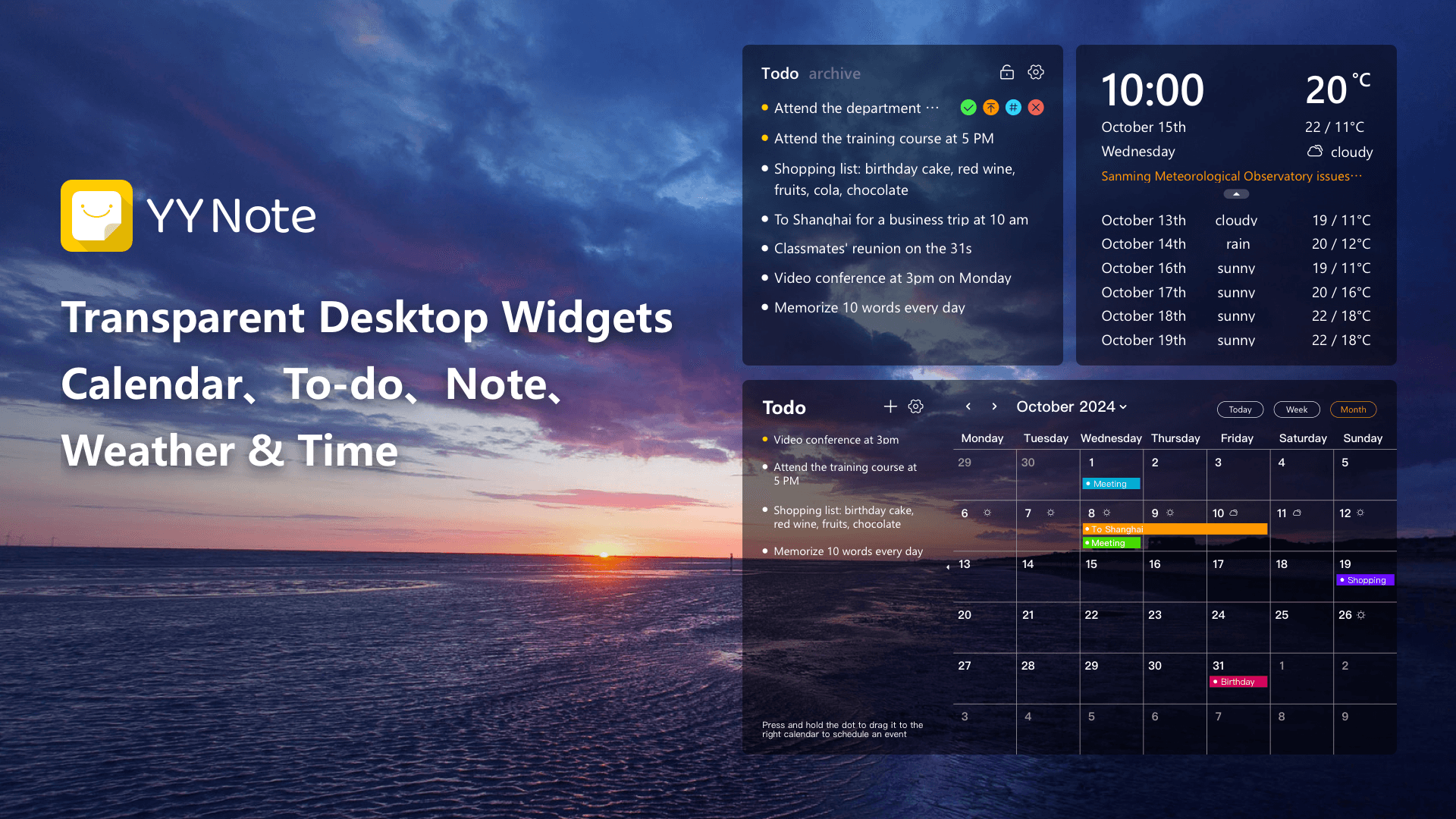
Say goodbye to clutter: Keep reminders on your desktop, not in your head
Traditional methods of event reminders, whether it is mobile phone memos, paper sticky notes, or silent reminders, have a fundamental shortcoming: they are not within the scope of your core work field of vision. You have to take the initiative to "remember" them, but in the current situation of information overload, forgetting is bound to happen.
The most efficient solution is to embed the reminder system directly into your work environment, which is your computer desktop. Just imagine, after turning on the machine, all the tasks to be done are clearly and visually displayed on the side of the screen. It is like a peaceful personal assistant that only appears when you need it. This is exactly what many highly effective people love. Changes brought about by desktop to-do list tools.
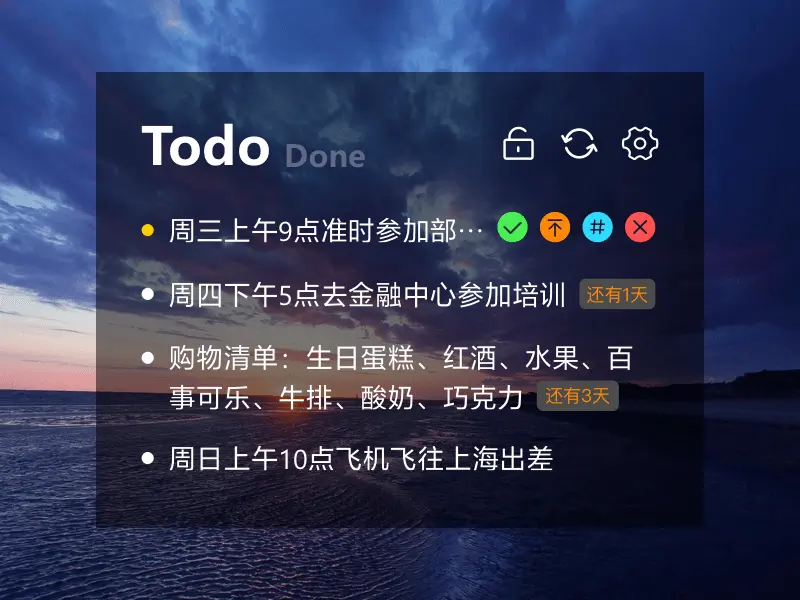
How to build an efficient desktop reminder system?
A desktop reminder system that really works well is not just as simple as listing tasks one by one. It should be based on the principle of "minimum effort, maximum return", making it almost difficult for you to realize the burden of management.
It must be intuitive and clear at a glance. All tasks are clearly arranged according to priority or time order. Important matters can be pushed to the top or highlighted with one click. You don’t need to open any application, just at a glance, you can grasp the key points of the whole day, and you will never miss key nodes because you are immersed in work.
It needs to be smart and convenient enough. For example, it has the function of supporting intelligent recognition of natural language input. You only need to write "Project report PPT to be prepared next Monday at 3 pm", and it will automatically recognize the date and time and set a reminder. For recurring items such as weekly meetings or monthly repayments, you can set a repeat mechanism, and the system will generate to-do items on its own later, thus completely freeing your memory.
Flexible classification is of critical importance. You can create multiple to-do lists based on projects, scenarios or personal habits, and use labels to implement refined management. For example, "Work List", "Personal List", and "Shopping List" are listed in different lists, or tasks can be quickly filtered using tags such as "#URgency" and "#, etc. Reply". When a new task is added to the list, preset tags can be automatically attached, making the organization effortless.
A considerate system will know how to protect your focus and privacy. Some tools are not very well designed. They are not fully transparent and cannot be integrated into the desktop wallpaper, which makes them look awkward. Unlike good tools, the fully transparent style can perfectly blend into the desktop wallpaper. When you want to concentrate on your work, good tools can be automatically hidden close to the edge of the screen, or you can hide them and bring them out again by using shortcut keys, ensuring a smooth workflow and preventing others from seeing the contents.
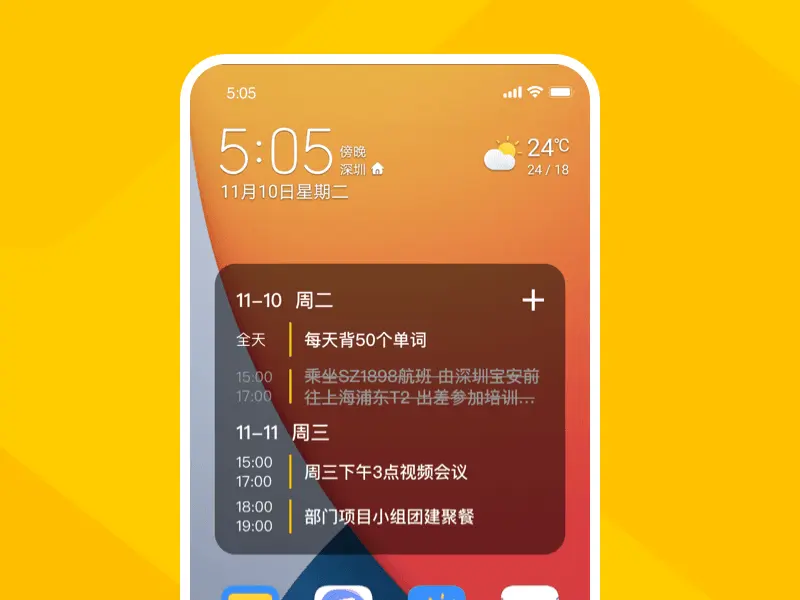
From memorization to completion, gain a leisurely work rhythm
When you start to activate such a system, changes will appear unknowingly. You don't need to be highly nervous all the time to remember. All tasks have a place to place them. Every morning, the list on the desktop helps you quickly plan what to do with important event reminders on the computer. Every time you complete an item, the moment you mark it off, you will feel a little sense of accomplishment. At the weekend, you can check the completed items that are automatically archived, and you can clearly see the results of the week.
This is not a simple management task, but about managing your attention and energy. The brain power you save can be fully devoted to more valuable creative thinking. The anxiety that arises from forgetting has disappeared and been replaced by a calmness and confidence that everything is under control.
Just like the "rustic year-end summary" that has been popular on the Internet recently, it resonates precisely because it sincerely records and reviews the hard work and harvest of the entire year in the most unpretentious way. The same is true for our work management. There is no need for complicated and cool methods. Finding a tool that allows you to record and review continuously and easily is the best way to achieve high efficiency.
If you're tired of struggling in a sea of notes and a maze of memories, it's time to try a more elegant approach. Let a professional desktop reminder tool help you take over those complicated and trivial things, so that you can concentrate on more critical and important things. Go and experience it now, and you will find that controlling work and life can be so easy.
Download Now → Unlock Desktop Efficiency Center:

Microsoft Store

Google Play

App Store