
Does this often happen to you: the project meeting only determines three nodes, but the customer has changed two requirements, and the mobile calendar and the computer schedule always fail to match up? As soon as I turn on my computer every day, I am faced with complicated to-do items and schedules scattered in various software, and I feel tired before I even start working. This dilemma of "schedules are scattered all over the place and planning is all based on memory" is secretly draining your concentration and efficiency.
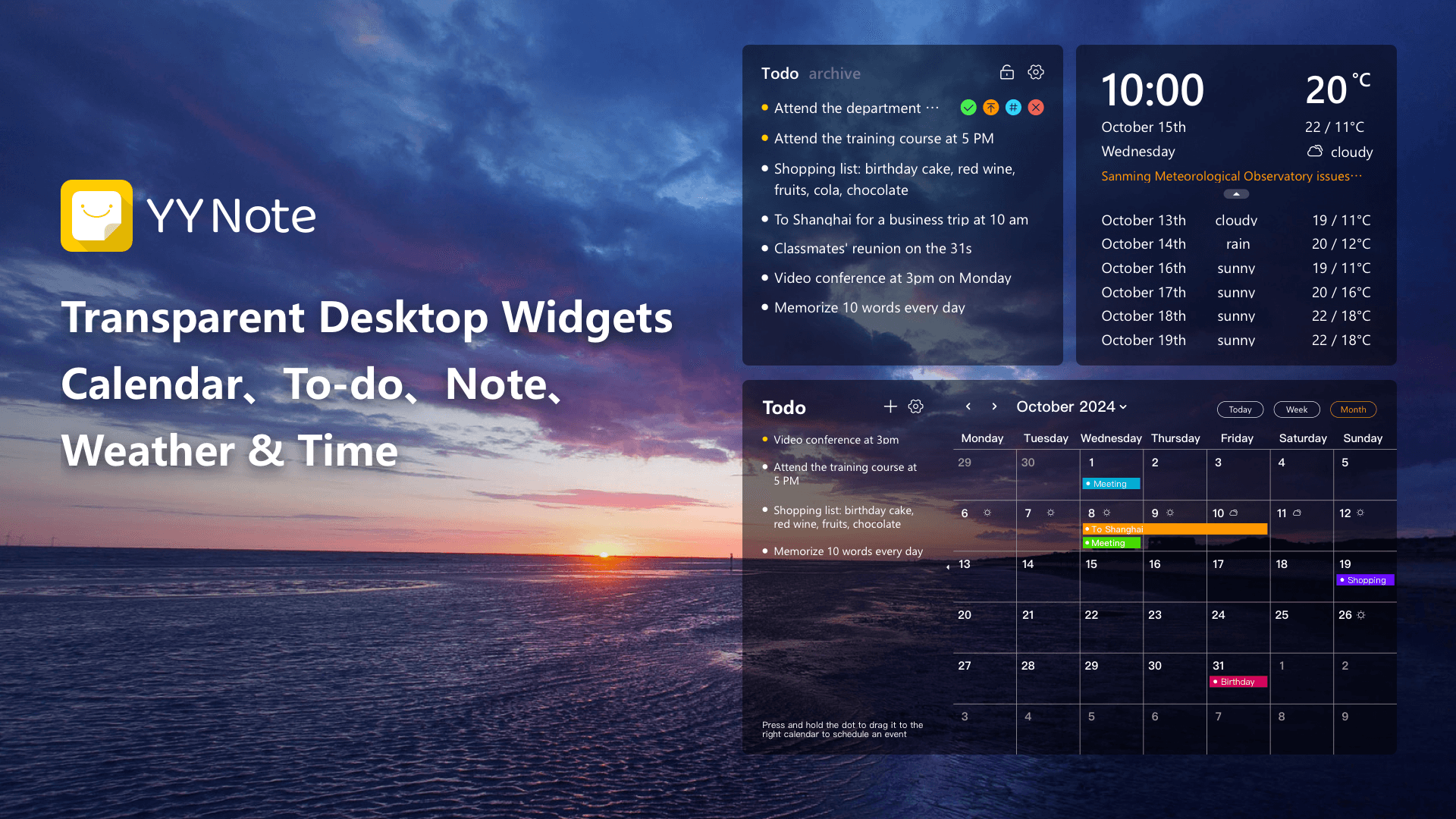
However, in practice, the real improvement of efficiency often starts with the most intuitive things that can be actually controlled. To imagine, there is a clear. The desktop calendar spreads it directly on your computer wallpaper. All meetings and deadlines within this week are clearly visible. To-do items can be directly dragged to any day on the calendar for planning. This is not a complex type of system; What YYNote brings is the minimization of visual management solutions. It presents the "map" of your work in a direct way on the area you view most every day, that is, the computer desktop. With the help of this presentation, you can obtain the most critical time information with minimal attention cost.

The greatest value of "pinning" the calendar on the desktop is that it eliminates the process of "searching" and "remembering". You no longer need to frequently switch windows or light up the phone screen to view arrangements, the overall planning view is always right in front of you. Regardless of whether it is in accordance with. Overview of the project cycle on a monthly basis, coordinate meetings and in-depth work on a weekly basis, or check hourly schedules on a daily basis . Switching views allows you to flexibly respond to different granular planning needs. More importantly, you can drag and drop the scattered tasks in your mind into the calendar grid. This visual arrangement process itself is a state of clarifying ideas and resolving anxiety, turning "everything is difficult at the beginning" into "planning by doing it."
Of course, more efficient tools need to be integrated into real workflows. If your schedule is already distributed on collaboration platforms such as WeChat, DingTalk, or Feishu, the ideal tool should be able to connect them instead of creating new information islands. By synchronizing these third-party calendars, you can gather all your schedules in one place on your desktop for unified management. At the same time, flexible overlapping rules can automatically generate periodic schedules such as weekly meetings and monthly reviews for you. On important days, you can also set up countdown reminder calendar boxes to record work, so that key nodes continue to receive your attention.

That real feeling of ease comes from a management style that is not intentional. When you have one that is always online and allows people to see everything clearly at a glance. With the desktop calendar, you will find that your sense of control over your work progress is significantly enhanced, and the number of emergencies caused by forgetfulness or confusion is greatly reduced. As a result, your desktop becomes tidy and organized. Whenever you look at the lower right corner of the screen, you can verify and fine-tune the plan for the day. What this work model imparts is precisely the efficiency concept of "minimum effort, maximum return": simplifying the complex and focusing on the moment.
Initiating change starts with a simple attempt. Rather than continuing to rush back and forth between many applications, it is better to experience the calmness of having all your schedule right in front of you and being able to control it easily. Start downloading now. YYNote opens a new chapter of your desktop efficiency for free, turning a clear vision and relaxed mentality into a solid foundation for your daily work.
Download Now → Unlock Desktop Efficiency Center:

Microsoft Store

Google Play

App Store