
At that moment, when you were concentrating on the work at hand, an improvement idea about an important project suddenly popped up in your mind, and because you were afraid of forgetting it, you quickly picked up the sticky note next to you and wrote it down in a hurry; when you were dealing with other matters a few hours later, you suddenly remembered the client you were going to follow up with tomorrow, so you hurriedly wrote it down. I hurriedly opened the memo on my phone to record it; in a blink of an eye, there were several blurry and long-expired sticky notes stuck on the computer screen. When I wanted to find the key information I wrote down last week, I had to rummage through my phone, computer, and notebook, and in the end I might not find anything. The chaos caused by this kind of information fragmentation and the subsequent forgetting phenomenon are silently consuming the energy and efficiency of many working people.
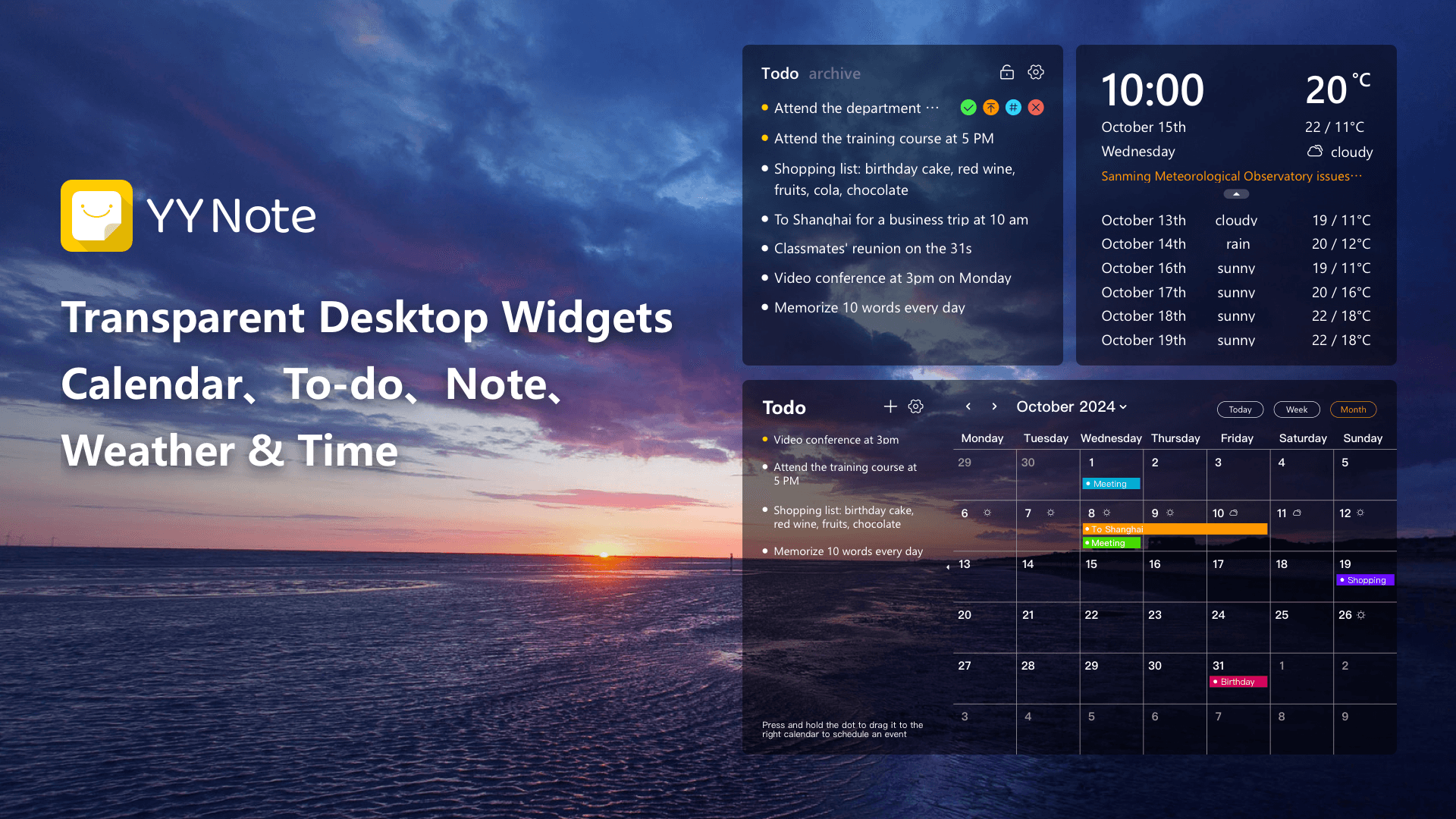
Such troubles are extremely common, just as people's pace of life is accelerating and the ways to obtain information are becoming more and more diverse. For example, out of the pursuit of self-discipline and time management, some people will purchase exquisitely designed self-discipline punch-in calendars and plan their schedules in the "Daily Tear"; while more modern office workers rely on digital tools to try to integrate all tasks and inspirations. However, whether it is a traditional paper planner or an independent application that needs to be opened and closed frequently, it seems that the fundamental conflict between "recording at any time" and "seeing at a glance" cannot be satisfactorily resolved.
The key to the problem is that most tools require you to "actively" enable it. You have to stop what you are doing, switch windows, open the application, type content, and then close it. This process not only interrupts the coherent thought process, but also makes the "recording" itself a burden. Your brain must always tell yourself "Don't forget to open the memo and take a look." This kind of ongoing implicit anxiety is the culprit of reduced efficiency.
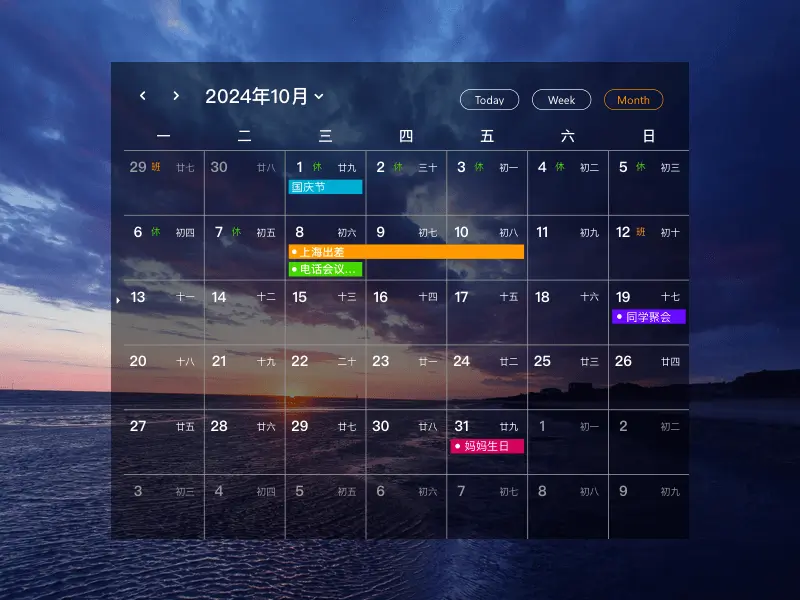
Is there a way for such a todo desktop gadget to turn your desktop itself into an efficient and organized "second screen"? The answer lies in a minimalist desktop to-do tool that does not require you to open it specifically. Instead, it floats silently and transparently on your existing desktop wallpaper, integrating with your work environment.
Conceive and imagine a certain scene. When inspiration suddenly strikes, you don't need to leave the current window. You can just touch and click on the transparent floating area on the desktop. Quickly perform the big action of typing, and your thoughts are instantly fixed within the range of your sight. Whether it's a to-do list, a temporary phone number, or an idea that flashes by and disappears like lightning, all these fragments of information have a clear, conspicuous place to belong. More importantly, this information is always visible. You no longer have to deliberately "review" your to-do list because you can see them as soon as you look up during your daily work. This always-on experience presents "zero switching," completely eliminating the possibility of being forgotten.
Going a step further, you can create multiple desktop to-do lists to achieve classified management of information. For example, place the "Core Projects for the Week" list on the left side of the desktop, and the "Meeting Minutes and Inspiration" list on the right side of the desktop. When you need to plan your schedule, you can even drag a to-do item from the list to the desktop calendar next to it to configure the schedule instantly. All operations are so natural and smooth that you don't feel the presence of the tool, but only enjoy the sense of order and control it brings.

This desktop tool is different from those bloated software that have complicated operations and occupy a lot of system resources. What it pursues is extreme lightness and a state where people can hardly feel its existence. Evaluation data shows that excellent tools of this type only take about 1.2 seconds to start up, and their memory usage can be as low as 28MB, which basically does not cause any burden on the computer. Its design is very exquisite, with a transparent background, which can be perfectly integrated with any style of desktop wallpaper. When you need to focus or leave temporarily, it can automatically hide under the edge to protect privacy.
If the high-frequency activity of "recording" is seamlessly integrated into your work routine, you will notice that the "memory" of your brain is liberated. The anxious feeling of "seeming to have forgotten something" will be significantly reduced. At the end of each day's work, looking at the to-do tasks being cleared or completed one by one on the desktop, the sense of control over work and life is the best reward for oneself.
This is exactly the idea that YYNote adheres to the work philosophy advocated by Xiao Huangtiao, which is to pay a very small price to reap a huge proportion of feedback in terms of efficiency. It is not just a tool, product, equipment, or measuring tool, but a clearer and more focused work approach model. To say goodbye to the hectic state of fumbling around in messy and trivial information, start by clearly displaying all the things that need to be done on your desk. Download and try it out immediately, making your desk an efficient starting point for work.
Download Now → Unlock Desktop Efficiency Center:

Microsoft Store

Google Play

App Store