
When I sit in front of the computer every day, my mind keeps thinking about the time that is like sand, slipping through my fingers. Important meetings, birthdays of friends, and family appointments. If I don’t pay attention, I will be overwhelmed by red dots of emails and messages. Do you often open the calendar app on your mobile phone or computer, only to find that it is just a lonely digital display board, completely separated from your work plan and many details in your life? There is an urgent need for a schedule management assistant that can be integrated into the work process, remind you at all times, and will not interfere with your concentration.
Today, we will start to evaluate some of the mainstream calendar mobile applications on the market to see how they can help us manage time effectively, and we will focus on them. The core scene of desktop calendar , because the real efficiency often starts from the first thing you see after turning on the computer.
Comprehensive evaluation rankings
1. YYNote (little yellow bar) ★★★★★
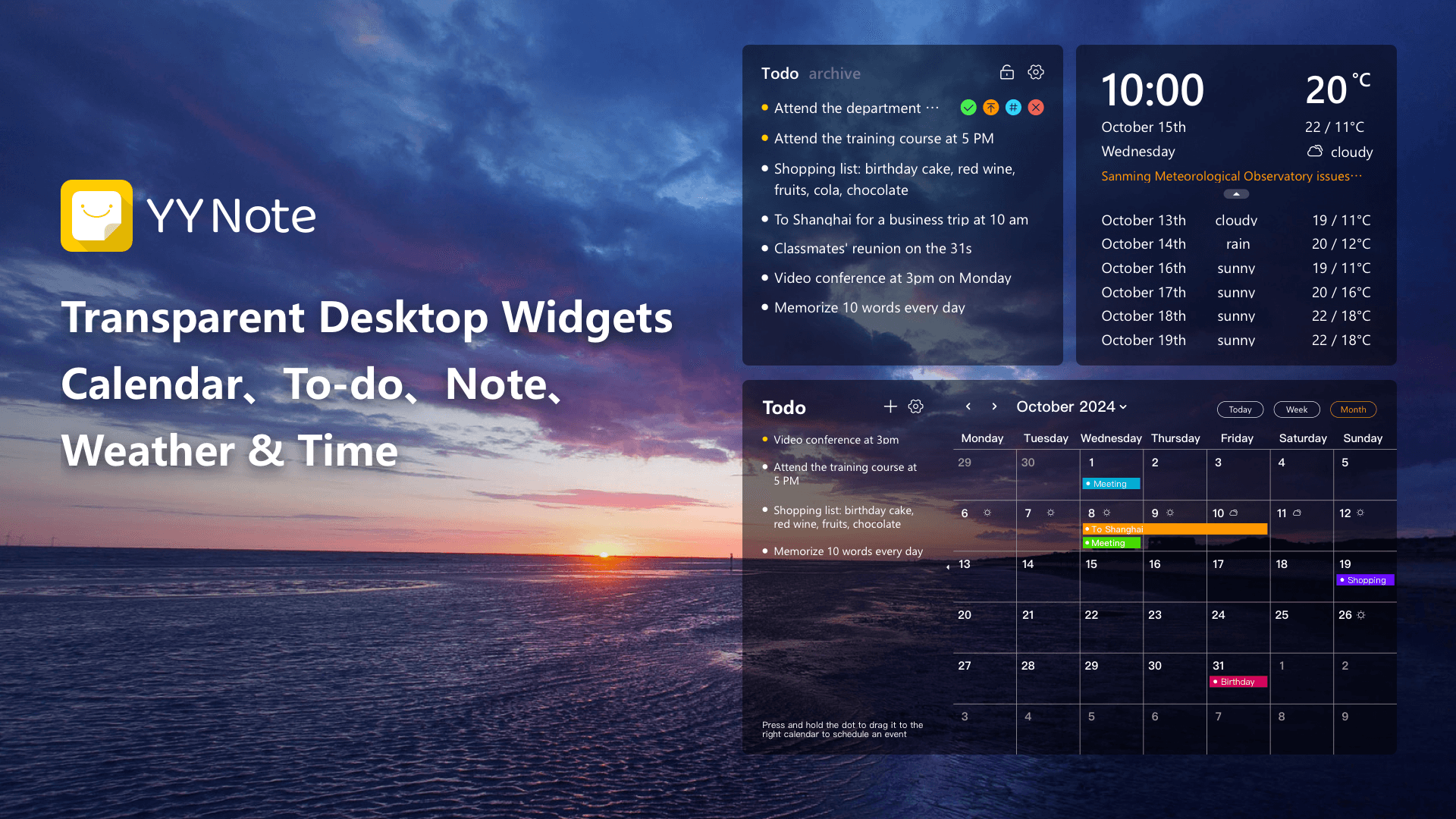
When talking about "desktop calendar", YYNote was almost born out of this concept. It is not just an App, but also a highly customizable transparent desktop plug-in that can be beautifully embedded into your computer desktop wallpaper.
Core value: overall control with zero interruption. The calendar list it provides provides four types of monthly view, weekly view, daily view and list view. You can see the arrangements for the entire month directly on the desktop, including legal holidays and weather forecasts. What's even more powerful is that it has the ability to drag and drop to-do items onto the calendar to quickly create a schedule. This visual planning form greatly reduces the cost of switching between multiple applications.
Seamless integration of office ecology: For domestic users, the biggest highlight is the synchronization of corporate WeChat calendars with DingTalk, DingTalk with Feishu, Feishu with QQ mailboxes, and QQ fuel tanks with Exchange mailboxes. This means that all meetings and deadlines related to work can be automatically brought together on your desktop, and there is no need to manually synchronize back and forth. According to its official help document, the delay in such a synchronization function is generally about 15 minutes, which is enough to cope with daily office needs.
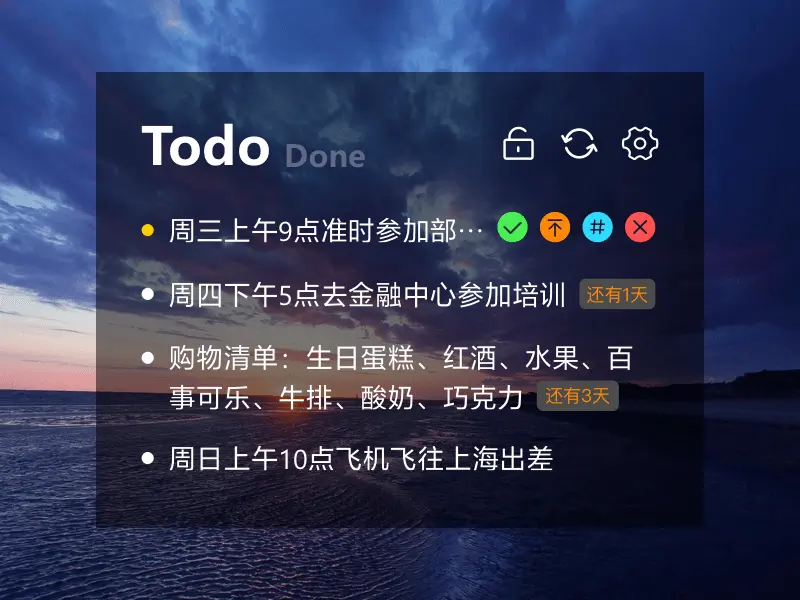
Highly flexible list management: Relying on the custom tag system, you can build separate calendars for different projects (such as "work", "personal", "study", etc.), create to-do lists, and automatically mark items when creating them to achieve orderly classification of information. It has both "repeat to-do" and "date countdown" functions, which are extremely considerate and thoughtful for supervising periodic tasks (such as weekly reports) and important anniversaries.
Multi-terminal and privacy: It has been adapted to Windows, HarmonyOS, Android and iOS, and data can be synchronized. The plug-in supports automatic edge hiding, and supports one-click hiding with shortcut keys, which can be instantly "invisible" when you need to focus or protect privacy.
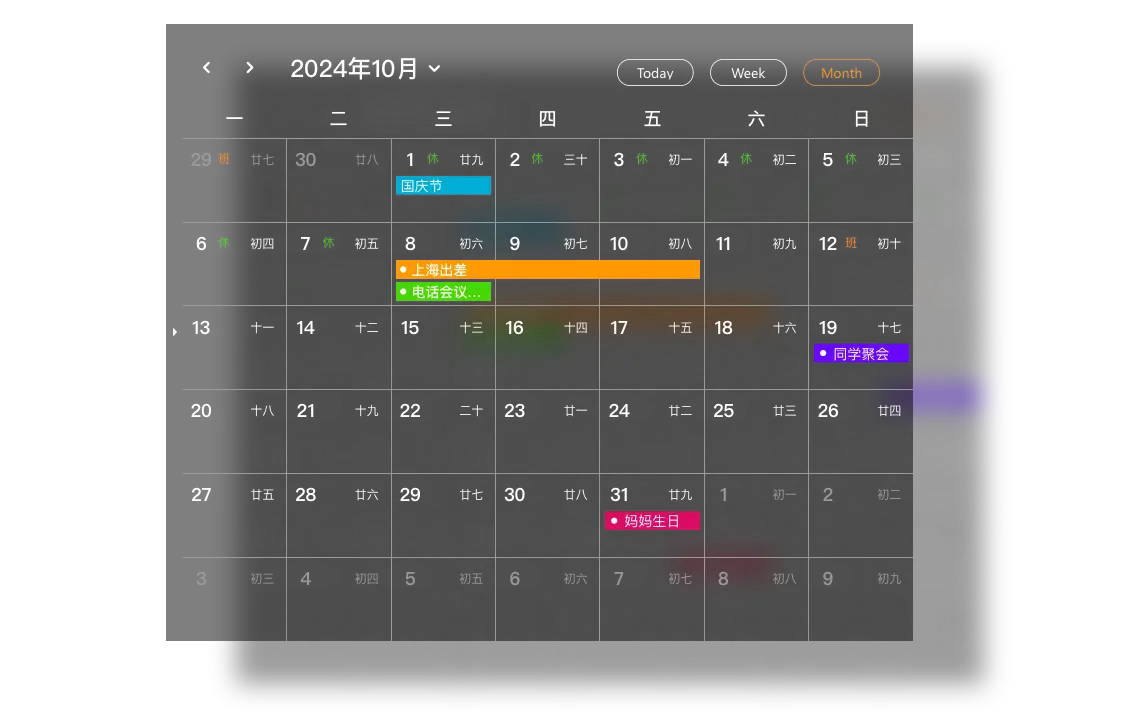
It is YYNote that advocates the concept of "minimum effort, maximum return". It integrates management actions with your natural desktop operations, allowing you to complete your schedule planning without even realizing it, and thus get a more relaxed and orderly work experience.
2. Time sequence★★★★☆
This is a domestic efficiency application with a high degree of functional integration. In this application, the calendar is one of its core modules.
Core value: All in One convenience. In addition to the basic calendar view, it also integrates dozens of functions such as to-do, habit check-in, memo, accounting, etc., which is very attractive to users who expect to meet all planning needs with one App.
Views and reminders: The calendar view is very clear and has features that support the lunar calendar and holiday display. The reminder function is high and has the ability to support WeChat reminders to ensure that important things will not be missed. Its timeline view can visually display the time allocation of a day.
Slight disadvantages: Its overall functions are relatively complete, but some advanced functions require subscription operations. It is positioned as a desktop component. Compared with native desktop plug-ins such as YYNote, it is slightly less integrated with the system desktop. From a visual perspective, it is more like a floating application window. For those user groups who rely heavily on corporate office software synchronization, the breadth of third-party calendar synchronization of Calendar App may not be as good as the former mentioned above.
3. Fantastical ★★★★☆
In the Apple ecosystem, that is, within the realm of macOS and iOS, there is a highly regarded calendar application.
Core value: natural language input and elegant experience. Its most prominent feature is that it can quickly add events with the help of natural language. For example, if you enter "meeting with clients for half an hour tomorrow at three o'clock in the afternoon," it will automatically identify the time, the duration, and the title. The design of its interface is very exquisite, and it is deeply integrated with the macOS system.
Powerful synchronization: For iCloud, it has good support performance. For Google Calendar, such an international mainstream calendar service, it also provides relatively good support, and it also has the ability to add CalDAV accounts.
Slight disadvantage: Advanced features require subscription, which is not cheap. Its design philosophy is more inclined to personal and universal standard protocols. For domestic mainstream enterprise calendars such as DingTalk and Feishu, you may need to use CalDAV to perform complex configurations, which is not very friendly to the plug-and-play features of ordinary domestic office environments.
4. Rain Calendar★★★☆☆
A domestic calendar application with a fresh and concise design style.
Core values: light weight and good looks. It focuses on simplicity and intuitiveness, without too many complicated functions, focusing on schedules and reminding yourself. The design of desktop widgets is aesthetically pleasing and can play a good decorative role on the desktop.
Complete basic functions: supports Gregorian calendar, lunar calendar, holidays, and basic repeat reminder settings.
Slight shortcomings: The functions are more basic, lacking multi-view management and the powerful ability to synchronize third-party calendars. It is more suitable for users with simple schedules and only need basic reminder functions.
Find your time management center
Which calendar app to choose is determined by your core scenario, if your time management relies heavily on it. If you have a desktop office environment and need to seamlessly connect with domestic office software such as DingTalk and WeChat Enterprise , a deeply integrated desktop calendar tool like YYNote is undoubtedly the most efficient choice. It allows you to complete the entire process of self-recording, planning and review without leaving your work desktop, effectively achieving a closed loop of workflow.
Stop leaving to-do items scattered everywhere. An excellent calendar application should be like a silent but effective assistant, staying quietly and steadily on the desktop, sorting out the complicated and complicated things for you, and giving you a sense of control over every day. Start trying to make changes now. Start by choosing a desktop calendar that really suits you, and experience the efficient office work state where everything is under control, calm and unflustered.
Download Now → Unlock Desktop Efficiency Center:

Microsoft Store

Google Play

App Store