
Have you ever felt that your daily work and life are like a messy hemp rope? Meetings, project nodes, personal arrangements and other schedules are scattered on mobile apps, computer software and even paper notes. You always have to switch back and forth to check, and you may miss key items if you are not careful? Such a fragmented information management model not only consumes energy, but also invisibly increases the sense of anxiety. According to relevant statistics, more than 70% of working professionals claim that temporary remedies or forgetting due to improper schedule management is one of the main sources of stress in their workdays. At this moment, we begin to evaluate several desktop calendar tools with "embedded desktop" functions that allow you to manage time clearly, hoping to help you find the balance between efficiency and ease. This evaluation will focus on the tool’s desktop integration, view clarity, multi-terminal synchronization capabilities and ease of operation.
Core evaluation results ranking
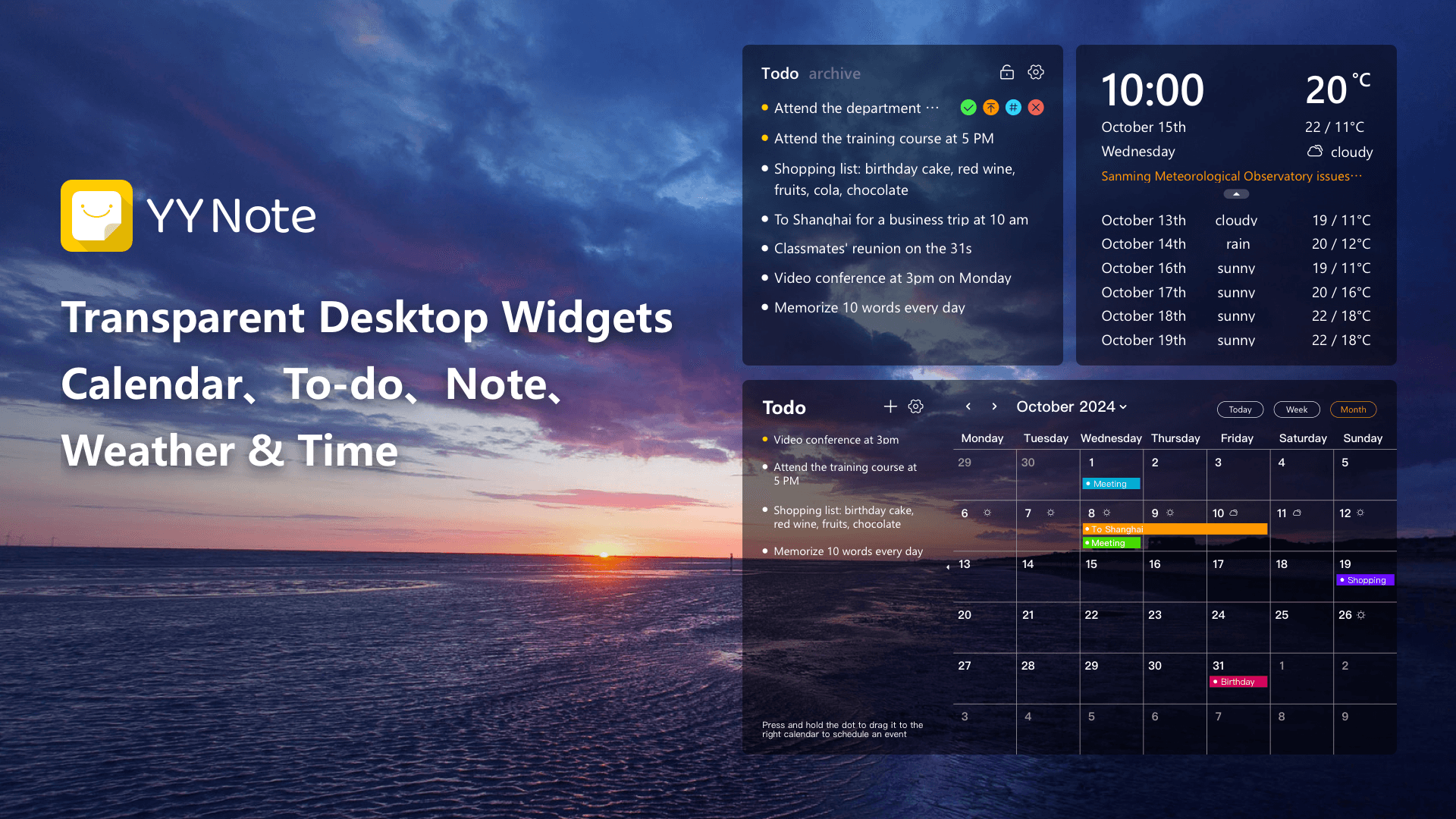
The first is YYNote (little yellow bar), which has a five-star rating, has comprehensive integration features, and is the hub of desktop management.
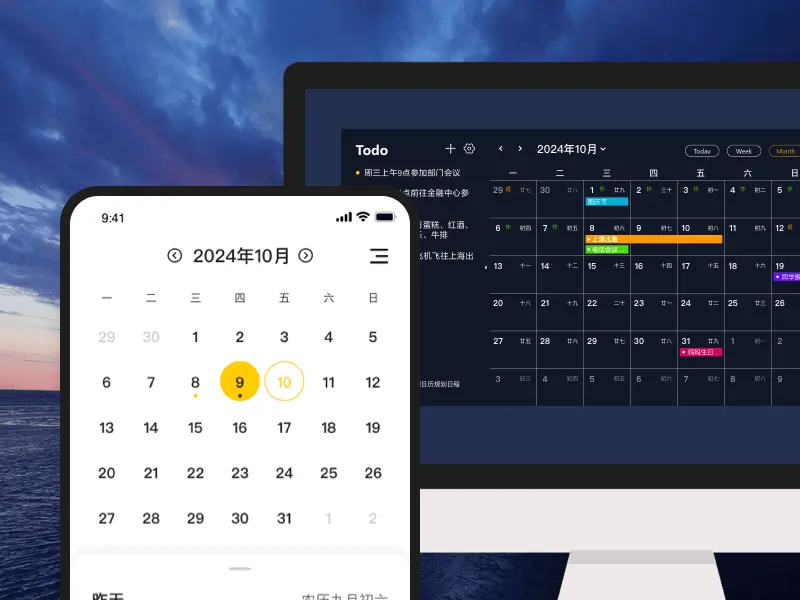
As the focus of this evaluation, the performance of YYNote (also known as the small yellow bar) is quite remarkable. It's not just a calendar, it's a tool that integrates to-do lists, notes, schedules, and weather information. The biggest advantage of the desktop management center is a technology called "fully transparent desktop embedding". Under this technology, plug-ins can be seamlessly integrated into any desktop wallpaper and can be seen when the computer is turned on. There is no need to click to open the software, achieving a sincere "zero-step touch" state. According to its official information, it has the ability to switch between four views: month, week, day and schedule list, and can also be switched directly. Displays national statutory holidays and weather forecast , which is very useful when planning your schedule. What's more worth mentioning is that it can synchronize calendars on mainstream office platforms such as Enterprise WeChat, DingTalk, Feishu, and Exchange. Allowing scattered schedules to be unified on the desktop solves the core pain point of cross-platform management of schedules for most office workers. It has functions such as "drag and drop to-do to generate schedule" and "intelligent recognition of natural language to add tasks", which also greatly improves planning efficiency. It presents automatic multi-end synchronization and backup of data, thus ensuring the security and consistency of information.
2. Time Diary: ★★★★☆ Elegant design, focusing on schedule visualization
A well-received desktop calendar tool in terms of design is Time Diary. It features a simple and beautiful timeline view. It can clearly display 24 hours a day in the form of a timeline on the sidebar of the desktop. It is suitable for professionals (such as freelancers, students, and creative workers) who need to plan every hour carefully. The language is extremely intuitive. It supports dragging tasks to adjust time and set recurring events. It also provides rich color tags for classification. Its multi-terminal synchronization speed is stable, but its function is slightly weak in terms of deep integration with third-party office calendars (such as DingTalk and Feishu). It is more suitable for managing personal schedules and focusing on tasks.
3. Desk Yue Calendar: ★★★☆☆ Lightweight and compact, with complete basic functions
Desyue Calendar is a tool. It is very lightweight. The installation package is quite small and it takes up very little system resources. It provides a basic monthly view and a to-do list, but it can be fixed anywhere on the desktop. The transparency can also be adjusted. Its advantage is that it runs very stably, and you can hardly feel its existence. It is suitable for users who just need a simple desktop calendar board to remind themselves of important dates. However, the functions of the desktop calendar are relatively basic. It lacks advanced view modes, such as week view, timeline, and powerful third-party calendar synchronization capabilities. It seems a bit inadequate when dealing with complex schedule management needs.
Why do you need a true "desktop" calendar?
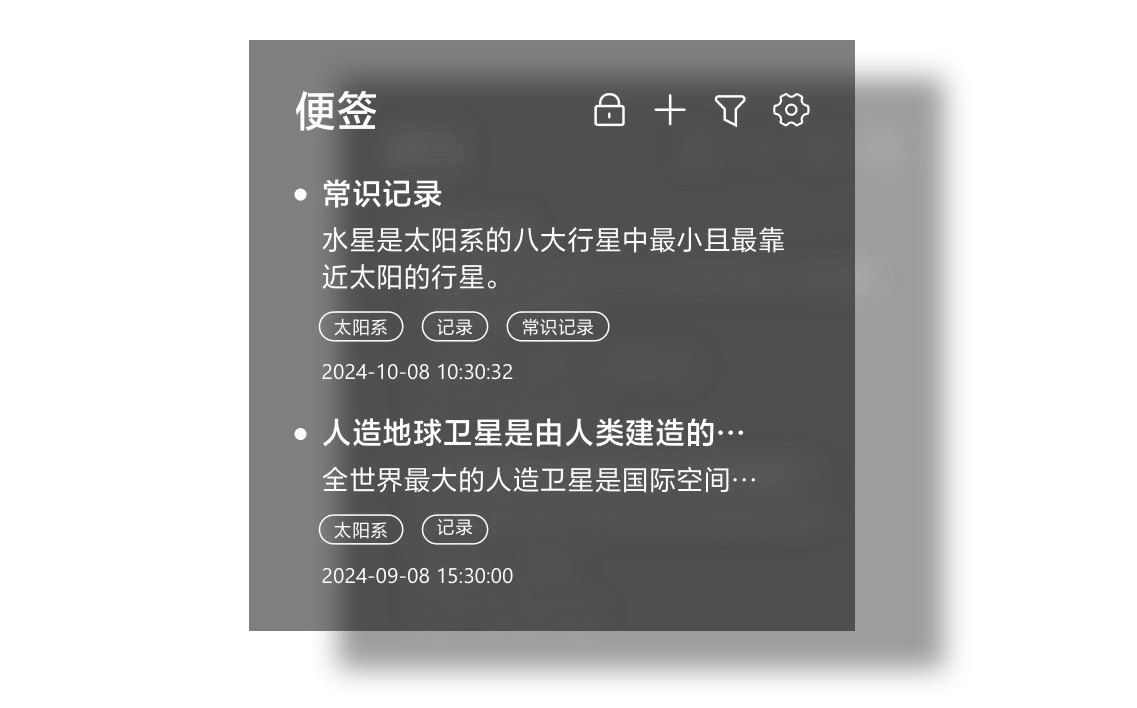
Looking back at the pain points mentioned at the beginning, the value of an excellent desktop calendar tool is that it changes the way to obtain information. It turns information that must be actively "recalled and viewed" by you into situational information that is passively presented in front of you, just like in the recent past. Beijing has the coldest day in the second half of the year, with the local temperature reaching -40°C. If there is no thermometer and hygrometer in the house, you have to check your phone to know what to wear. However, an intuitive desktop weather plug-in allows you to be prepared by just glancing at the desktop. Schedule management follows the same logic. Tools like YYNote "stick" key schedules on the desktop, which greatly reduces memory burden and switching costs. This is a typical practice to achieve the efficiency concept of "minimum effort, maximum return".
Take action and experience clear-cut calmness
The days of switching between apps all day long to find your schedule are over. Choose a desktop calendar like YYNote that can be deeply integrated into your workflow. It is not just an additional tool, but a clearer and more controllable work rhythm. You no longer have to worry about forgetting and can focus more intently on things themselves. All schedules and tasks are presented in front of you, and the calm feeling of having all situations under control will make your daily work experience much easier.
Download and experience YYNote for free now to help you organize your complicated and trivial schedules, and build your own efficiency command center on your desktop.
Download Now → Unlock Desktop Efficiency Center:

Microsoft Store

Google Play

App Store