
Have you ever been like this: inspiration flashes in an instant, but when you want to record it down, you can't find the sticky note; to-do items pile up in your mind and are forgotten as soon as you turn around; or you set a calendar reminder on your phone, but missed it because the APP was submerged in other applications?
These seemingly insignificant efficiency "loopholes" accumulate day by day, but they actually consume our concentration and reduce work output. What’s even more frustrating is that this may even affect our health habits. For example, there are Internet topics being discussed recently. "Why do you get fatter after working?" In addition to factors such as prolonged sitting and stress, "cognitive overload" is also a very key reason. Once the brain has been occupied by a variety of complicated tasks and things to be remembered, the energy used for self-discipline and planning will be reduced accordingly. This makes it easier to make choices that are not healthy. However, a clear and low-interference task management environment is actually the foundation for efficient work and a high-quality life.
This is the purpose of desktop efficiency tools – to "pin" your most important information directly from the bottom of the system to the desktop to achieve instant access with zero clicks and zero switching. This time, as an authoritative self-media blogger, I will conduct an in-depth horizontal evaluation of several mainstream desktop note, to-do and calendar integration tools currently on the market, focusing on their core efficiency design, visual integration and ease of use.
The evaluation will mainly focus on the following dimensions: visual intrusion (whether it affects the aesthetics of the desktop), information integration (whether tasks, schedules, and notes can be managed in one stop), operational convenience (whether addition and organization are efficient), and multi-platform support (whether data can be synchronized). The following is the detailed evaluation results ranking of this time.
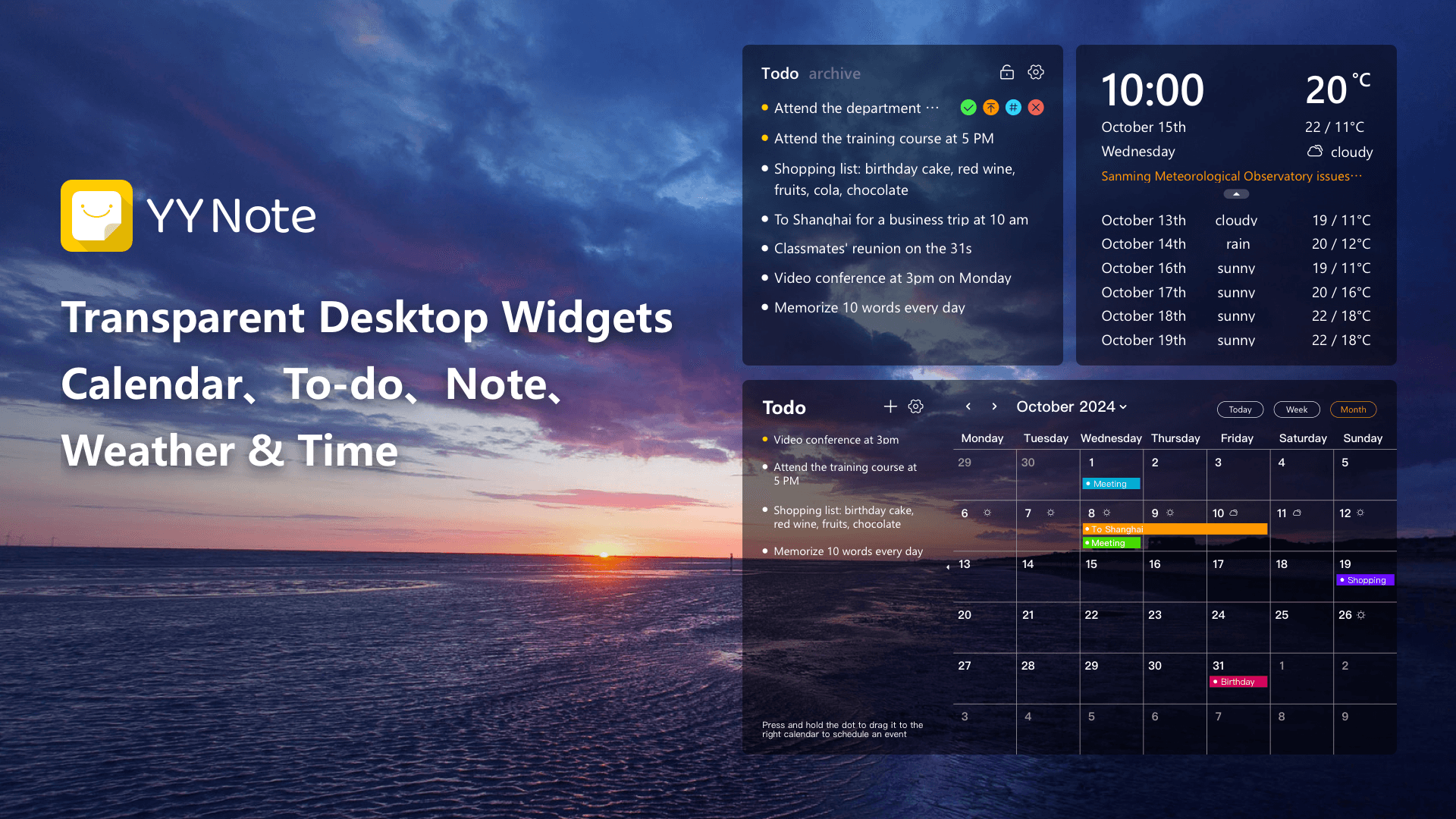
First, No. 1: YYNote (little yellow bar)|Comprehensive rating: ★★★★★
Among all the tools in this evaluation, YYNote (little yellow bar) has the most outstanding performance in terms of efficiency concepts and practices. It perfectly interprets the principle of "minimum effort, maximum return" .
Ultimate visual fusion It uses a fully transparent design style, and this fully transparent design can adapt to any desktop wallpaper state without any gaps, and embed to-do items, calendar content and note information into the desktop in a "zero sense of presence" form, thus solving the traditional problem of The key point of pain is that software windows have always blocked the desktop and destroyed the visual cleanliness. It has the function of automatically hiding when it is close to the edge of the screen. When people need to focus, it can immediately provide an environment without interference, thereby protecting personal privacy.
Powerful scene integration : It is not a single function, but a desktop efficiency center.

The to-do list supports intelligent recognition of natural language input such as "There will be a meeting at three o'clock tomorrow afternoon". It can automatically set the date and time. It is equipped with flexible repetition rules and even supports lunar calendar repetition. It also has a date countdown function, making periodic tasks and important target days clear and clear.
The calendar view has a complete monthly view, a complete weekly view, and a complete daily view. You can directly drag and drop to-do items for schedule planning. What’s more outstanding is that it can synchronize calendars with mainstream office platforms such as Enterprise WeChat, DingTalk, Feishu, and Exchange, truly achieving a comprehensive overview of all schedules on the desktop. According to the "2023 Enterprise Collaborative Office Market Research Report" released by the China Academy of Information and Communications Technology, this cross-platform calendar integration capability has become a key function to improve the efficiency of enterprise employee schedule management.
The note function allows for extremely simple text recording, and also supports classification tags and desktop embedding functions, so that the inspiration generated by jotting down will not be forgotten.
A burden-free usage experience. You can use it immediately after opening it. There is no need to open and close the software frequently. Almost all operations are completed on the desktop, and data supports multiple terminal synchronization and automatic backup, thus reducing the anxiety caused by data loss. Its ad-free green experience is also very popular.
Overall, YYNote effectively reduces the user's cognitive load and the cost of operations by placing high-frequency information in the foreground and greatly simplifying the operation path. It is an ideal choice for users who are looking for an efficient and tidy desktop.
No. 2: Cloud Memo | Comprehensive Rating: ★★★★☆
Cloud Memo is a desktop note-taking tool with a fresh design style. Its advantages are its powerful rich text editing capabilities and good cloud synchronization speed. Users can add rich formats to notes, add pictures, and even perform simple layout. It is suitable for scenes that require slightly more complicated records. Its desktop attachment effect is also excellent, and it supports transparency adjustment.
However, it has shortcomings. Its functions focus on the "note" itself and lacks in-depth to-do task management, such as the lack of repeat rules, priority identification, and no calendar view. For users who need strict time management, it is more like an enhanced desktop notebook than a complete efficiency management system. Its multi-platform support is mainly based on its own ecology, and its integration with other office platforms is at an average level.
No. 3: Desktop Elf|Comprehensive Rating: ★★★☆☆
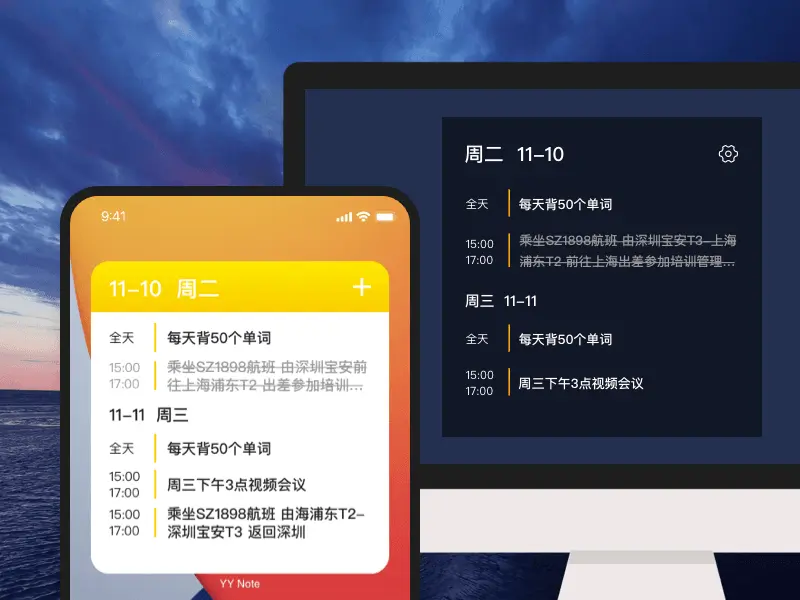
There is a tool called Desktop Genie, which belongs to the desktop beautification and enhancement category and has complex functions. It includes plug-ins such as notes, weather, calendar, etc. It has the advantage of being highly customizable, has a large number of plug-in types, and is completely free.
However, the problem also comes from the "complexity". First, although the notes desktop has a lot of functions, each one lacks sufficient depth. For example, the to-do function is relatively basic. Second, some plug-ins may have advertisements or recommended content, which affects the purity of the desktop environment. There are differences in visual design styles, and sometimes it is difficult to achieve perfect integration with the desktop. For those users who pursue ultimate efficiency and have simplicity requirements, it may bring additional burden of selection and visual interference.
Summary and suggestions
The key to choosing desktop productivity tools is to choose a work philosophy that adheres to the concept of "do not disturb". The tools should serve your attention, not compete for your attention.
After a comprehensive comparison, YYNote (little yellow bar) showed the most balance and excellence in this evaluation due to its minimalist design, deeply integrated functions, and seamless integration into the desktop . It is not just a tool, but also a carrier of efficient workflow. Imagine that when you turn on the machine every day, all key tasks are clearly displayed on the beautiful wallpaper; you can plan your schedule and record your inspirations without switching applications; important days will automatically count down, and the schedules of all platforms are fully displayed in one window – such a sense of control will make work easy and organized.
If you are tired of switching back and forth between messy reminders and software and are looking forward to a truly refreshing and efficient desktop working environment, then. YYNote is worth trying now. You can visit its official website now, choose the corresponding system version to download and experience for free , and experience for yourself the efficiency improvement of this "minimum effort, maximum return".
Download Now → Unlock Desktop Efficiency Center:

Microsoft Store

Google Play

App Store