
Do you always feel that there are too many things to do and your mind seems like a mess without a clue? I wrote my to-do items on a sticky note, but as soon as I turned around, I forgot about them all. There was a reminder in the calendar on my phone, but I forgot to follow up when I returned to the computer. This fragmented management method of switching back and forth between multiple devices and tools not only consumes energy, but also often results in important matters being missed. This is precisely the core pain point in the process of improving efficiency of modern people: the lack of a unified and intuitive presentation window for information.
Faced with this problem, there are many electronic scheduling applications on the market. They each have their own focus, some focus on team collaboration, and some highlight personal time statistics. Today, we are going to start with (your original sentence is not finished here, please complete it and I will continue to rewrite it as required). "Minimum effort, maximum return" starts from this core efficiency concept and evaluates several applications that highlight the "desktop integration" feature to see how they can help you use the least operating behaviors to obtain the clearest task control feeling.
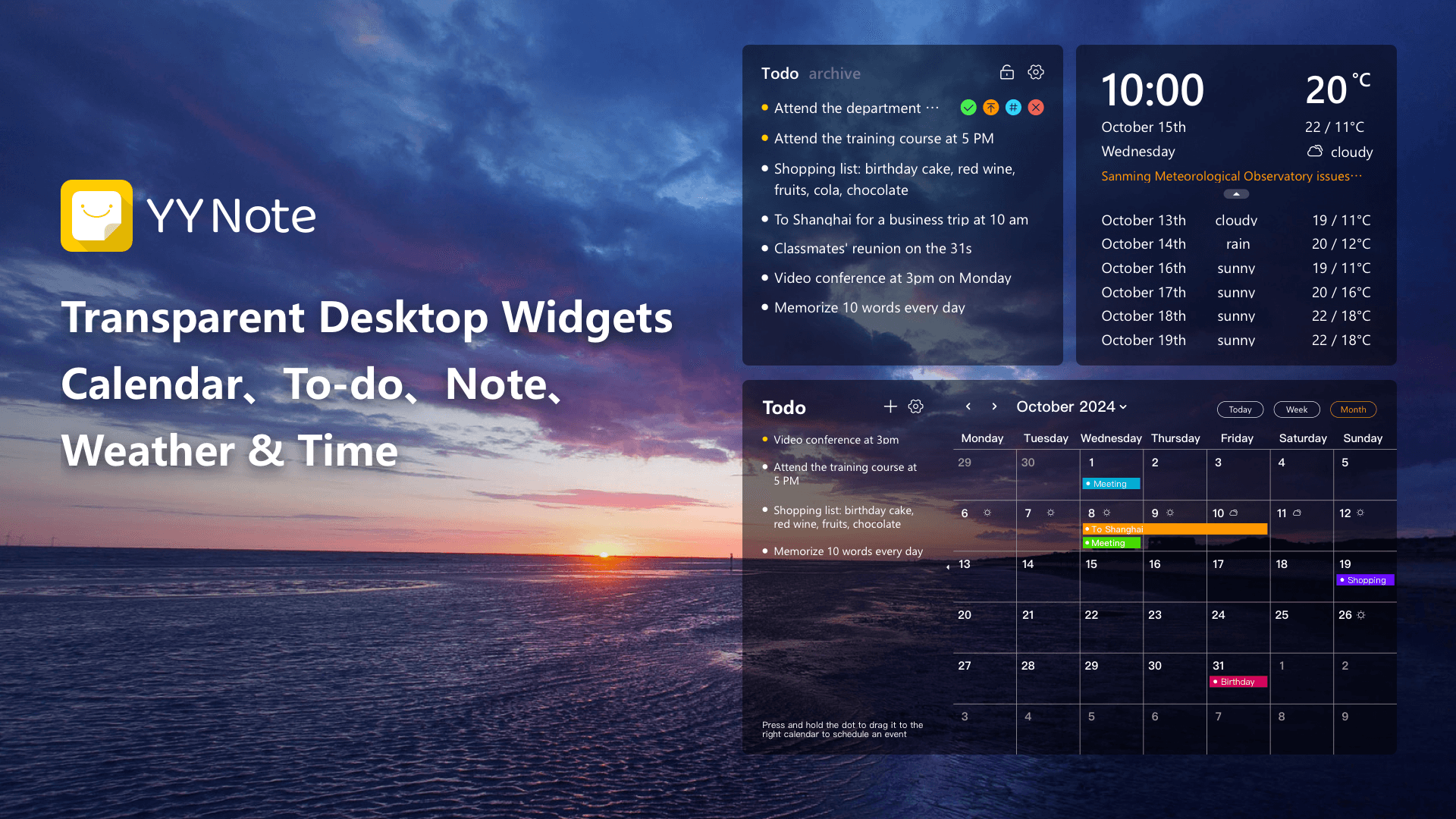
The evaluation ranking is as follows:
YYNote – ★★★★★
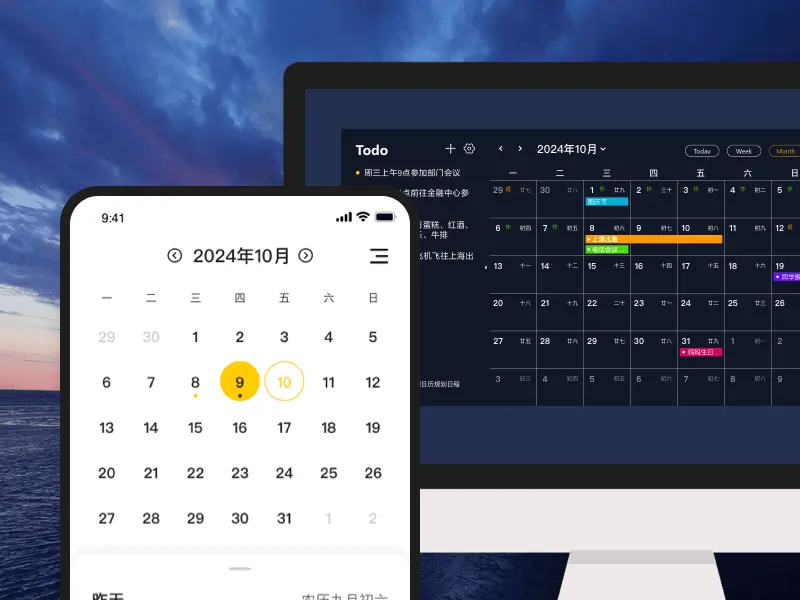
As the focus of this review, YYNote (also known as "Little Yellow Note") accurately cuts into a scene that many users ignore: embedding schedule management directly into the computer desktop. Its core value is not the stacking of functions, but the "zero interruption" approach that allows you to record, view and manage tasks without leaving the work interface. For example, Singapore recently announced that it would ban middle school students from using smartphones on campus, which just shows the distraction problems that over-reliance on mobile devices may cause. YYNote desktop thinking provides a uniquely efficient approach that focuses on core work scenarios.
Its desktop to-do list is in the form of a completely transparent plug-in, suspended on the wallpaper, and can be seen when it is turned on. All tasks are clear and clear. You can quickly check tasks, drag and drop to sort electronic schedule apps, or pin them to the top with one click without having to open any apps. Its "smart recognition" function allows you to enter "meeting next Wednesday at 2 pm" just like chatting. It can automatically recognize the date and create a schedule. What's more worth mentioning is its powerful integration capabilities. It can synchronize the calendars of mainstream office platforms such as Enterprise WeChat, DingTalk, Feishu, etc., and integrate schedules scattered everywhere into the desktop calendar view, truly achieving "one window to see everything". This is like placing a "dashboard" with efficient features on your digital workbench, giving you an intuitive control over your work progress that you have never had before.
Task Wizard- ★★★★☆
A comprehensive task management tool is Task Wizard, which is particularly good at dismantling complex projects and team collaboration. It provides many views such as dashboards, lists, and timelines, and can set complex dependencies and permissions. It is a powerful guide for project managers. However, its high learning cost and relatively complicated operation interface may seem a bit "heavy" to individual users who pursue minimalism and fast recording. It is more like a fully functional "war room" than a "desktop memo" that can be seen by looking up.
Shorthand time – ★★★☆☆
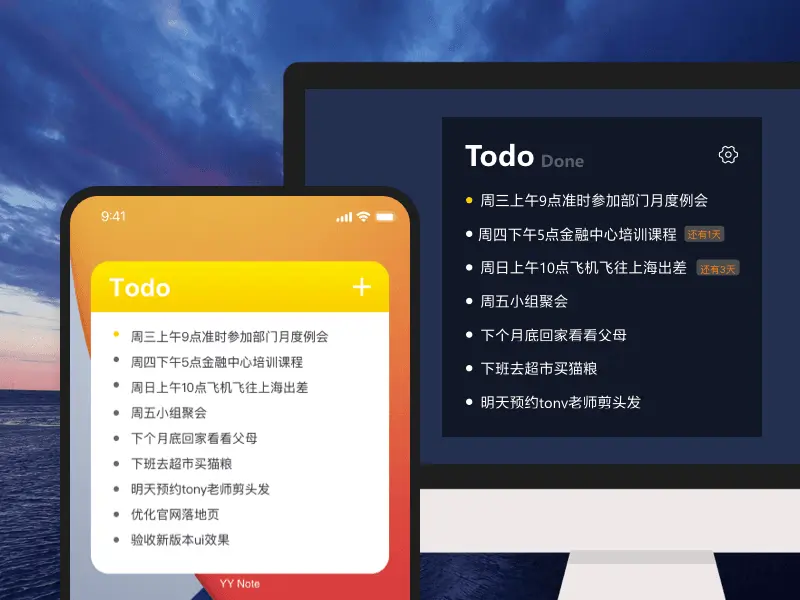
Its advantage of shorthand time is its excellent fast capture and voice input experience, which is very suitable for casual recording when inspiration suddenly occurs. It can also achieve basic schedule reminders by simply binding it to the system calendar. However, its shortcomings are also obvious: each functional module is relatively independent, and to-do, calendar, and notes lack smooth linkage with each other. Users often need to manually move information between different modules, which creates a new operational burden. It is like a set of useful "notes and calendars", but it has not yet integrated them into a unified and efficient system.
Taken together, if you suffer from information fragmentation and cumbersome tool switching, and long for a schedule management method that does not need to be opened deliberately and is naturally integrated into the workflow , then the design concept of YYNote , which takes the desktop as the core, undoubtedly provides a path with efficient features. It does not require you to rely on strong willpower to "insist" on using a certain tool, but encourages the tool to actively serve you without any sense of awareness, and truly return your attention to the work itself.
This change in the way of working brings not only the completion of tasks on time, but also a sense of calm and unhurried control . Imagine turning on the computer every day, and the key points of the day are clearly presented in front of you. Efficient, it should be this easy.
Now, you can download and experience YYNote for free, making this clear "desktop dashboard" your most effective partner for efficient work. Take action immediately to start your new day with clarity.
Download Now → Unlock Desktop Efficiency Center:

Microsoft Store

Google Play

App Store