
When I turn on my computer every day, I use minimalist to-do windows. The desktop is full of files. The to-do items are crowded in my mind. I want to find the important things I recorded yesterday but can’t think of them. Are you familiar with this feeling? Information overload and complicated work tasks are a common problem today. The efficiency dilemma that people in the workplace commonly face, according to a study in the journal "Frontiers of Psychology", shows that visual clutter will significantly increase cognitive load, reduce attention and task switching efficiency, and a clear and orderly visual environment is particularly critical for enhancing concentration and work output. This is the core value of the "desktop to-do" tool we are going to discuss today.
After selection, I conducted an in-depth experience with several mainstream Windows desktop to-do software currently on the market, in order to find efficiency tools that can truly help us achieve the goal of "minimum effort and maximum return". My evaluation criteria focus on several core dimensions: visual interference (whether it is concise enough and can be integrated with the desktop), operational convenience (whether adding and managing tasks is efficient), functional practicality (whether it has necessary functions such as reminders, classification, and repetition), and overall stability . This review will focus on their actual performance in realizing the concept of "minimalism".
The following are the detailed results of this evaluation:
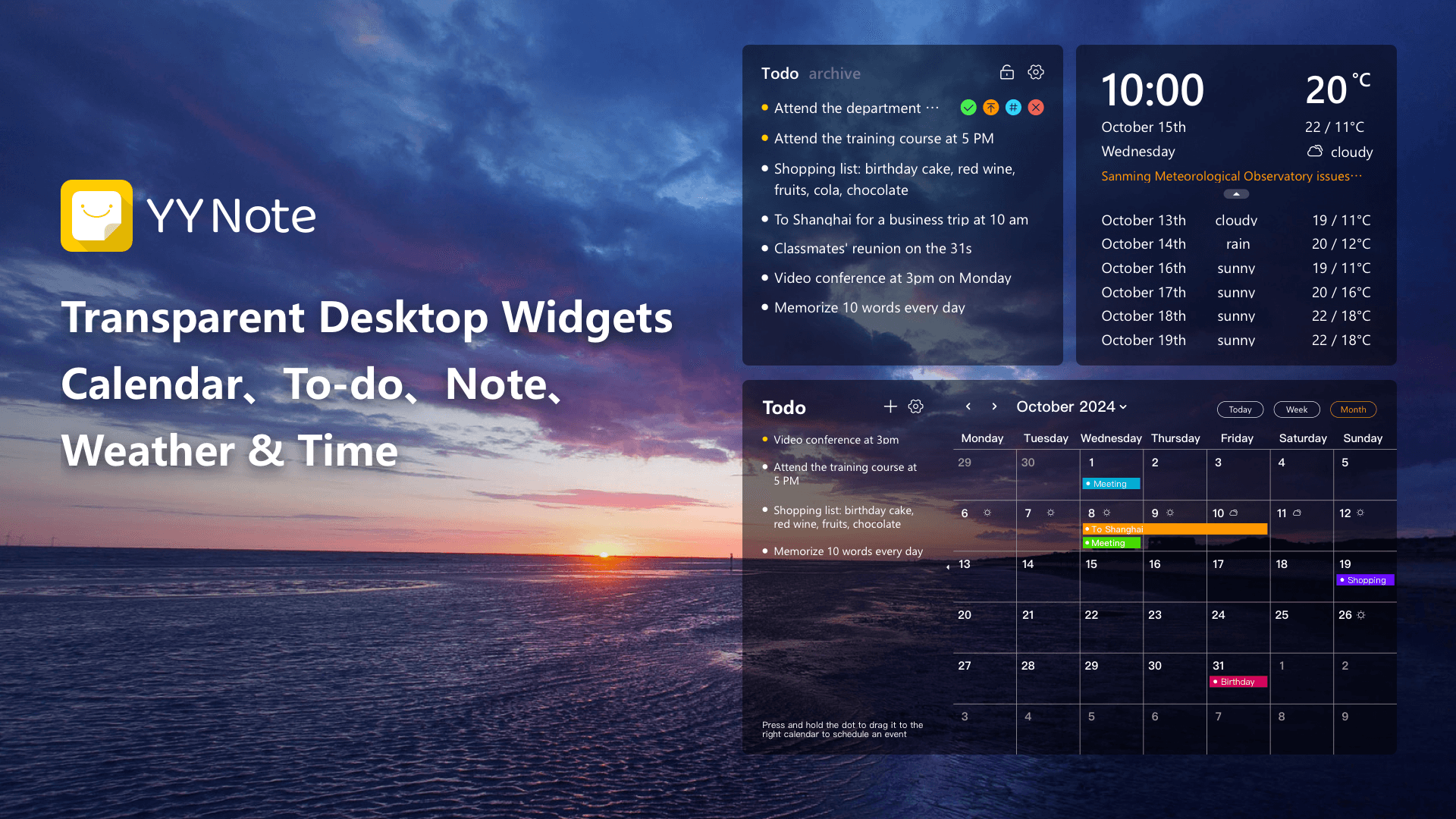
YYNote (little yellow bar): Its score reaches 10/10, which is a benchmark product that adheres to the minimalist concept.
In this review of YYNote , its performance is the most outstanding. It perfectly interprets the connotation of "minimalist to-do". The "minimalist" here does not mean that the functions are simple, but that complex functions are presented in the most senseless and convenient way.
Its desktop embedding experience plug-in uses a fully transparent design. This design can seamlessly fit any style of desktop wallpaper and truly become a part of the desktop, rather than a floating distracting window. After booting up, all the things to be done are clearly displayed, and there is no need to click extra to open the software. This kind of "zero-click" view greatly reduces the operating steps. Its design concept is consistent with the principle of "externalized memory" in cognitive psychology to reduce brain load.

The operation is extremely efficient and supports intelligent recognition input. For example, just input "meeting at 3pm tomorrow", it can automatically identify the date and time and set reminders. Tasks can be sorted with simple drag and drop, and important matters can be pushed to the top with one-click operation. What's more practical is that. The flexible repetition rules and date countdown function can be set up and automatically generated to-do items, whether it is a weekly meeting or a family member's lunar birthday, and important deadlines will be clearly displayed in the form of countdown labels, thus bringing continuous time urgency management.
It achieves refined classification of tasks by creating multiple lists through the label system , while maintaining an extremely clean interface. At that time, just move the mouse close to the edge of the screen, and you can quickly call it out or hide it. This perfectly protects work privacy, so to speak. YYNote frees users from the complicated and trivial management tool itself, allowing users to fully return their attention to the status of the task itself.
2. Flashpoint List: Rated 8/10, a comprehensive productivity assistant
Flashpoint List is another player with strong capabilities. It also supports desktop embedded displays, and its design style is modern and clear. Its core advantage is. The task management function is very comprehensive and supports sub-task functions, task dependency functions, priority four-quadrant matrix functions and other advanced functions. It is an extremely powerful tool for users who have complex project management needs and for those who need to dismantle tasks.
It provides ample view switching, such as list view, Kanban view, etc., to adapt to management needs in different situations. The reminder function is also very reliable and supports multi-platform notifications. However, compared to. In comparison, YYNote performs poorly in terms of "minimalism" and is also slightly lacking in "senselessness". Although the desktop component it has can have embedded operations, in terms of visual effect, it is more like a separate application window placed on the desktop, and the integration with the desktop is slightly weak. In addition, some of the advanced functions require a certain level of learning costs, which may seem a bit complicated and heavy for those users who are pursuing "just turn on the computer and use it without thinking at all".
3. Notes: Rated 6.5/10, a lightweight and fast note-like tool
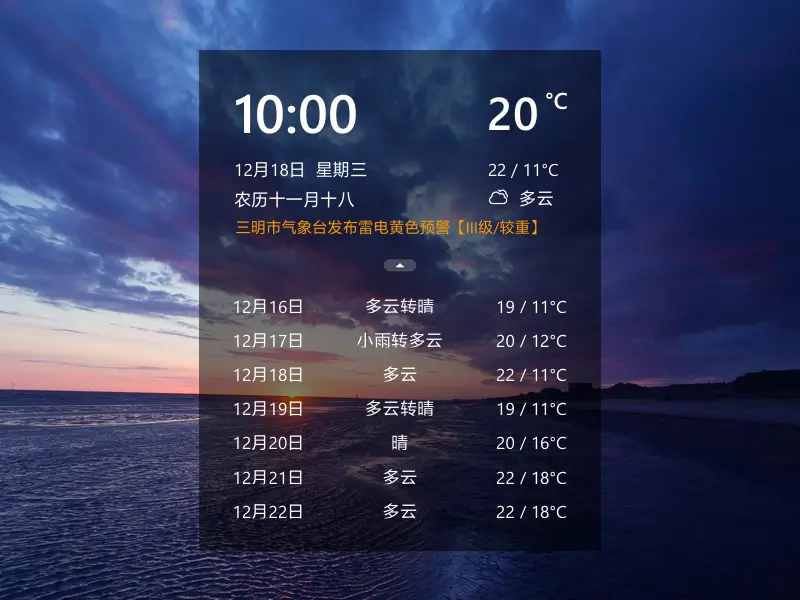
Notes As the name suggests, this software focuses on fast and casual writing. Its advantage is that it is extremely lightweight and quick to start. It can be like a digital post-it note. You can easily paste multiple to-do items anywhere on the desktop. Adding tasks is extremely fast and direct. It is suitable for recording temporary matters that do not require complicated management.
However, its shortcomings are also obvious. First, the function is relatively single and lacks a strong reminder system, repetitive task setting and scientific classification management capabilities. All "post-it notes" are stacked on the desktop. Although they are placed randomly, they can easily lead to new visual clutter. When the number of to-do items increases, management will become difficult. It is more like a quick recording tool rather than a systematic to-do management structure, and it is difficult to shoulder the burden of planning complex daily work.
Summary and action suggestions
After comprehensive comparison, YYNote (little yellow bar) has significant advantages in the core track of "minimalist to-do". It hides powerful functions behind a simple and intuitive interface, achieving the ideal situation of "tools serving people, rather than people adapting to tools". It makes you unaware of its existence to a large extent, but it always provides you with clear task planning and time guidance. This is the auxiliary condition required for the "flow" state pursued by efficient work.
If your core appeal is to manage tasks with minimal effort, keep your desktop clear, and focus on the work itself , then YYNote is undoubtedly the best choice. Its design philosophy is similar to the concept contained in the recently hotly discussed topic on the Internet : "In this '5 million', there is an innovative China's future" . Real innovation is not necessarily a huge thing, but practical creations that can accurately solve daily pain points and significantly improve the quality of life and work with the help of small improvements.
At this time, you can say goodbye to clutter and forgetfulness, and experience a work rhythm with clear characteristics, efficient characteristics, and the ability to control all situations. Download YYNote for free now to make it the quietest presence on your desktop and the most effective partner in efficiency, making it easy to start an efficient and orderly day.
Download Now → Unlock Desktop Efficiency Center:

Microsoft Store

Google Play

App Store