
Every day, when you turn on the computer and face the complicated work tasks and trivial and scattered schedules, do you often feel that your thoughts are chaotic and numb, and important things are forgotten as soon as you turn around? Many people are accustomed to recording their schedules in mobile applications. However, when they need to use it, they have to switch out of the current work to view it, which greatly reduces efficiency. If you want to be able to see all the things to be done at a glance and directly transform the computer desktop into an efficient command center, then adding a schedule icon or plug-in to the desktop is the most direct solution.
There are many such tools on the market. They often take the form of transparent plug-ins that "stick" calendars, to-do lists, notes and even time and weather directly on your desktop. They are visible when you turn on the computer, without the need for additional clicks. This not only allows you to have an idea of the day's plan, but also can invisibly prompt you to advance the task through the method of "visual persistence". Today, we are going to evaluate several mainstream desktop scheduling tools to see which one can best help you achieve an efficient work experience of "minimum effort, maximum return".
Evaluation ranking
YYNote ★★★★★
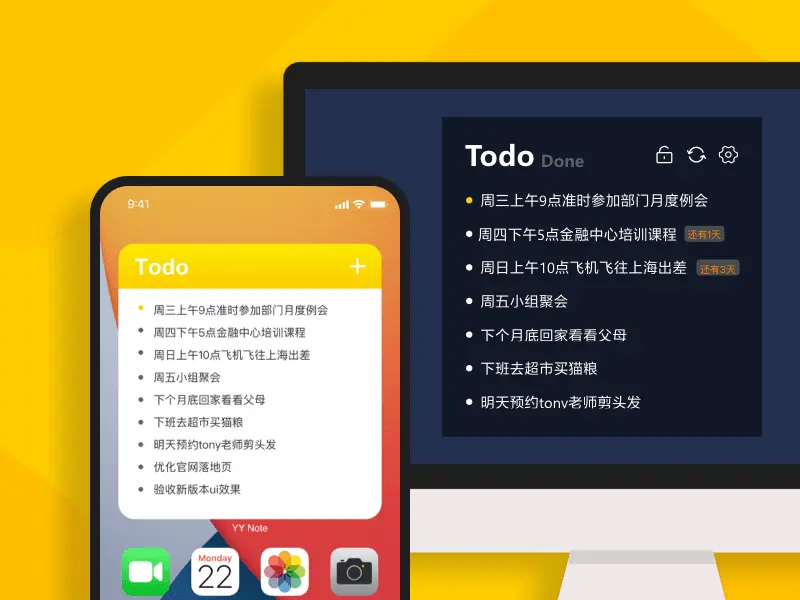
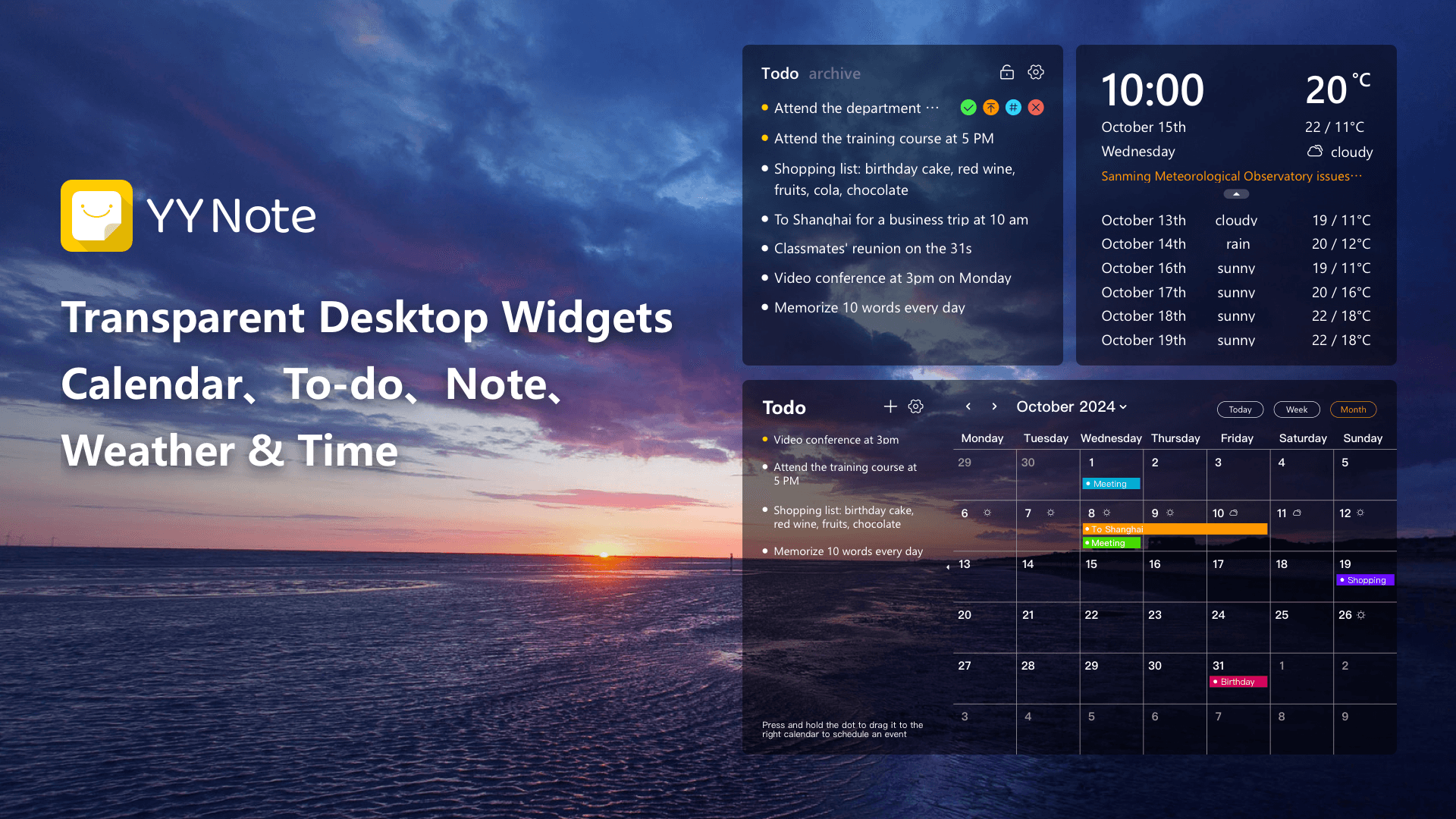
If you are looking for such a tool, it has all-round functions, has a refreshing design, and can penetrate deeply into the desktop to become an efficient choice. Xiao Huangtiao said that it is the best choice in the current comprehensive experience, which is true. It is not just a schedule icon, but a relatively complete desktop productivity suite that integrates to-do tasks, calendar arrangements, note records, and time and weather conditions. That's where its core strength lies. The ultimate "no sense" experience — this plug-in uses a fully transparent style design, which can achieve perfect adaptation effects. How to add a schedule icon to the computer desktop, the adaptation object is any desktop wallpaper, there is no sense of oppression in terms of visual experience, the situation is as if the schedule information is originally part of the desktop.
The core pain points it solves are very precise: difficulties in forgetting and planning . Its to-do function is supported by intelligent recognition. If you just enter something like "meeting at 3 o'clock tomorrow afternoon". It can set the appropriate date and time by itself. For recurring events, whether it's a weekly meeting or a family member's lunar birthday. It can be flexibly set up and reminded on time, so there is no need to worry about missing anything in the future. What is more worthy of mentioning is its. The "Desktop Calendar" view can view schedules on the desktop in a month/week/day format, and supports dragging to-do items for quick planning. Planning the schedule is as intuitive and easy as arranging chess pieces. According to its official website, the tool also supports syncing calendars from mainstream office applications such as WeChat Enterprise, DingTalk, and Feishu, allowing you to manage all schedule sources on your desktop.
DeskMemo ★★★★☆
This is a lightweight tool that has a good reputation among foreign users. Its main features are "Quick Capture" and "Smart Reminder". You can call up a simple input box anywhere on the desktop to quickly record ideas or tasks. At this time, it will generate a note icon and fix it on the desktop. It has a relatively powerful reminder function. It supports reminders triggered by geographical location, such as reminders after arriving at the company. It also supports reminders triggered by specific applications, such as reminders to view a link when opening a browser. However, its interface design is relatively traditional, and its level of customization and beautification is not as good as that of the small yellow strip. Its support for localized functions such as the lunar calendar and holidays in the Chinese environment is relatively weak.

ClearWindow ★★★☆☆
Jian Chuang has the characteristics as its name suggests, which is the pursuit of minimalism. You see, it provides a text window that is very clean and can also customize fonts and colors. You can use it as a purely desktop to-do list, or as a quote and aphorism board. It has the advantage of occupying almost no system resources and running stably. However, its functionality is relatively simple. It lacks advanced functions such as calendar view, task drag and drop planning, and multi-terminal synchronization. Therefore, it is more suitable for users who only need to place a fixed text on the desktop, or place a simple task list.
Taken together, Xiaoyangtiao has outstanding performance in terms of completeness of functions, outstanding achievements in ease of use, and is unique in its deep integration with workflow. It turns the seemingly complicated schedule management into a visual interface that is natural on the desktop and can be used easily. No need to switch between multiple apps, all key information is clear and clear. This efficient situation of "you can see it when you turn it on, and what you see is what you get" has been truly achieved. This not only helps you grasp every task steadily, but also reduces the memory pressure on your brain with clear planning, making you more focused and relaxed when working.
Putting aside clutter and forgetfulness, a clearly organized desktop is the best starting point for you to start a productive day. Try it now. Xiaohuangtiao, hurry up and download it now to experience it, so that the desktop becomes your personal efficiency assistant, and then you can feel the unprecedented clarity and calmness in your work.
Download Now → Unlock Desktop Efficiency Center:

Microsoft Store

Google Play

App Store