
Do you often sit in front of the computer and your schedule is full, but you always feel uneasy and don't know when the next key meeting is or when the deadline for a certain project is? Switching back and forth between various calendar apps to check will not only interrupt your train of thought, but also make it difficult to build an overall concept of time. This feeling of inability to control time is secretly damaging your efficiency and concentration.
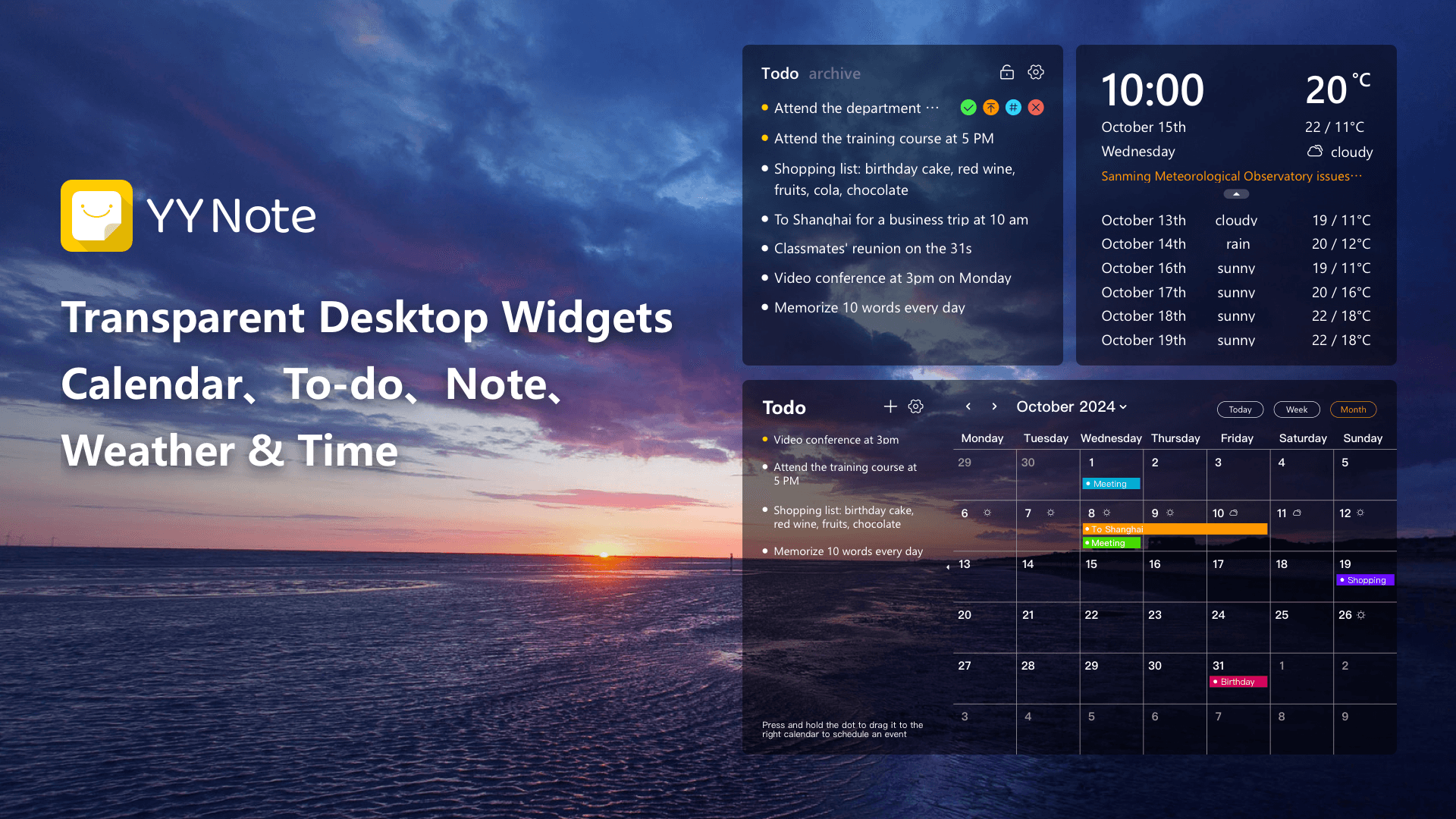
Don't worry, a clear and intuitive desktop calendar may be the "sense of order" you are longing for. Try to imagine that all the listed to-do items, as well as the specific arrangements for each meeting, as well as the relevant information of each project node, are all presented quietly on your computer desktop in the form of a view on the calendar, making it easy to understand at a glance without any hindrance. You don't need to open any software to view it. As long as you raise your head slightly, the context of the entire time will be able to come into your eyes, very clearly.
It’s not just about putting a calendar on the table. A truly useful desktop calendar tool should fit seamlessly into your workflow. For example, you can easily drag and drop the tasks in the to-do list to any day on the calendar to instantly complete the schedule planning. When it comes to regular team meetings that are held every two weeks, or customer visits that are fixed every year, you can set flexible repeat rules, and it will act like a trustworthy assistant, automatically building a future schedule for you, saving you the complexity of repeating it.

What's even more outstanding is that it can help you integrate fragmented information. Whether it is meeting invitations sent by the company's corporate WeChat, schedule planning on DingTalk, Feishu, or even plans in your personal Outlook mailbox, all can be synchronized to this single one. In the desktop calendar , you no longer need to repeatedly switch back and forth between different applications and check carefully. All schedules are gathered in one place, effectively avoiding forgetfulness or conflicts caused by scattered information.
Since it generally supports the use of labels to classify the calendar desktop, allowing you to focus on key points, you can exercise the right to set labels for "Project A", "Learning Improvement" and "Family Affairs" respectively, and selectively display them in the calendar view. In this way, when you need to focus on the current project, you can filter out other distracting information with one click, so that the interface only displays the things you are most concerned about.
The design of a good desktop calendar should have sufficient "non-feeling" characteristics. It uses a transparent background and can be elegantly adapted to each of your desktop wallpapers. It looks like a native part of the system. You can adjust its transparency, size and position at will, so that it has a sense of presence without overpowering the center. When you need to concentrate on the current window, it can intelligently hide it by the side, or use shortcut keys to instantly exhale it, providing vision when needed and keeping quiet when you are focused.
First, we experienced China’s ancient wisdom of “water management” in Dujiangyan, and now we use tools to manage our own time flow. The core of this is to establish a clear and efficient order. There is an intuitive one. The cornerstone of your desktop calendar is the time order that exists in your digital work environment. It allows you to gain a great sense of control over the progress of your work, say goodbye to busyness and anxiety, and rely on minimal energy investment.
It’s time to upgrade your time management. Download it now to experience it, and let the clear desktop calendar become an extremely effective work efficiency partner on your desktop, opening up a new work experience that is calm and under control.
Download Now → Unlock Desktop Efficiency Center:

Microsoft Store

Google Play

App Store