
When you go to work every day, you are faced with a screen full of sticky notes, scattered task reminders in several software, and those trivial things that you can never remember at critical moments. Do you also feel irritated and powerless again and again? According to the "2024 China Professionals Efficiency Tool Use Report", more than 67% of professionals stated that scattered information and complicated tools are the main reasons for their low work efficiency. The desktop, the work area we face the longest every day, should be the starting point for efficiency, but it often becomes a source of confusion due to the lack of a clear and unified management center.
This is the core of our review: to find a desktop to-do list tool that can actually be embedded into the desktop and help you achieve the situation of "minimum effort, maximum return". . We will make an in-depth comparison of several mainstream desktop to-do tools on the market from the four key dimensions of visual interference, operational convenience, functional integration, and cross-platform experience .
The results of the evaluation will be presented in the form of rankings. We use the overall experience score, which is a full score of 5 stars, as the standard. The following content is the detailed results of this evaluation:
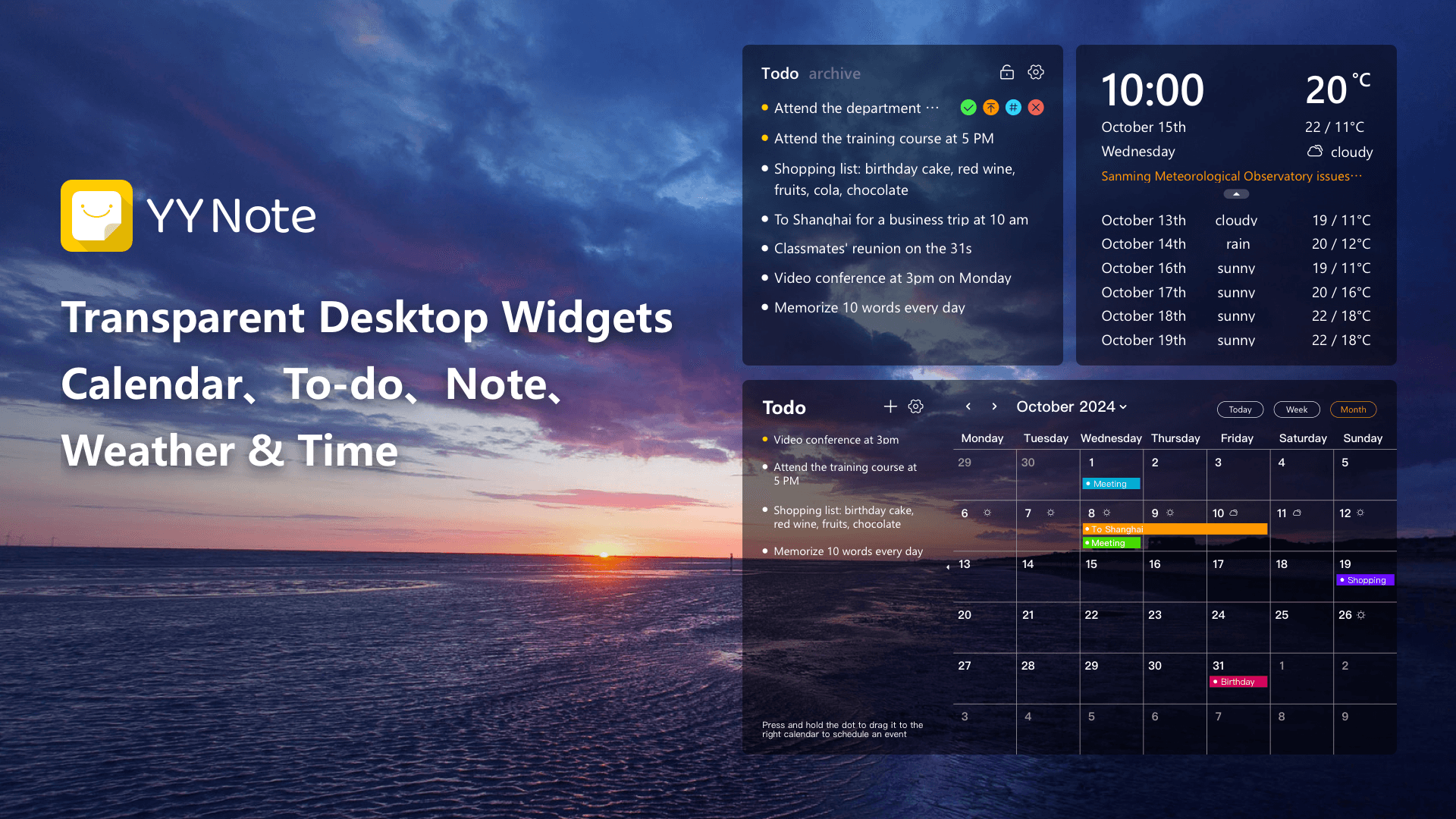
First place: YYNote|Comprehensive rating: ★★★★★
As the focus of this review, something called a small yellow bar in YYNote gives a completely different idea of "desktop to-do" than others. It is not a separate software window that you have to open frequently, it is a. A fully transparent plug-in directly embedded in the system desktop means that your to-do list, calendar and notes, like part of the wallpaper, can be seen when you turn on the computer without any extra operations. Its core value lies in "senseless integration":
The extremely simple design with zero visual interference and the transparency adjustment function with a high degree of freedom allow the list to be blended into any desktop background without any violation, effectively achieving the effect of "you can clearly see it at a glance when you need it, and you can quietly disappear without a trace when you are focusing on doing things."

The operation is extremely convenient and supports intelligent recognition of input situations. For example, inputting "meeting at 3 o'clock tomorrow afternoon" can automatically set the date and time. It also has the ability to drag and drop the mouse to quickly sort and plan the schedule, as well as the function of one-click to pin important items to the top. Its "category tags" and "automatic archiving" functions make task management in an orderly manner.
Deep feature integration : It's more than just a to-do list. During the evaluation, we found that it can seamlessly integrate the four major modules of to-do, calendar (including holidays and weather forecast), notes, and time and weather on the desktop. You can directly drag the to-do items placed on it and place them in the calendar view area to arrange your schedule. This smooth linkage greatly reduces the cost of switching between different applications. According to its official detailed instructions, this tool also supports the function of synchronizing third-party calendars such as corporate WeChat, DingTalk, and Feishu, achieving the purpose of centralized management of information.
Full platform coverage has been adapted for Windows, HarmonyOS NEXT, Android computer to-do, and iOS. The benefits enjoyed by members can be used on multiple terminals, thus ensuring the continuity of workflow.
Second place: Cloud Trail List | Comprehensive rating: ★★★★
A to-do application called Yunji List has an elegant design and comprehensive functions. It has a powerful task decomposition function, sub-task setting function and team collaboration function. Its natural semantic date recognition function is also quite outstanding. However, in the specific scenario of "desktop to-do", there is a core experience breakpoint: although it provides desktop widgets, there is still a gap in the intuitiveness of information and directness of operations compared with solutions that are fully embedded in the desktop. Users usually need to enter the main interface of the application to perform more complex management. For those users who pursue the ultimate "one-stop control" desktop workflow, this distance affects the smoothness of efficiency.
Third place: Flashpoint Memo | Comprehensive rating: ★★★☆

Flashpoint Memo has a more prominent advantage, that is, it starts up extremely quickly and is extremely lightweight. It is particularly suitable for quickly recording temporary ideas and to-do items. The method of exhaling through shortcut keys is its obvious highlight. However, in terms of systematic task management, its functions are relatively weak, lacking advanced functions such as repetitive tasks, advanced reminders, and classification tags. It is more like a digital sticky note that can be used quickly, rather than a desktop to-do center that can plan and manage complex workflows. For those users who have a heavy workload and are in urgent need of long-term planning and review, its capabilities are slightly lacking.
Summary and selection suggestions
It can be clearly seen that with the help of this review, the key to choosing a desktop to-do tool lies in how you understand "efficiency". If what you need is an independent task management center with powerful functions and you are willing to accept a certain degree of interface switching,. Cloud Trail Checklist is a good choice. If you just need to capture bits and pieces of information quickly, Flashpoint Notes is lightweight enough.
But if you are pursuing a more fundamental efficiency improvement – you hope that the desktop itself will become the command center of your work, controlling all matters with the smallest expenditure of attention, and achieving a natural integration of work processes. , then the "transparent desktop integration" concept represented by YYNote is undoubtedly the best solution. It is like a quiet and efficient assistant that places messy information in the right place, allowing you to focus more on the work itself, rather than the tools for managing your work. This kind of experience of "minimum effort, maximum return" is exactly the work philosophy favored by highly effective people.
Now, rather than continuing to waste energy on many applications and a messy desktop, it is better to try this new desktop management method. Go to YYNote official website. Download it now and experience it. All your to-dos, schedules, and flashes of inspiration are clearly visible, and you are in a relaxed atmosphere where your work is fully under control.
Download Now → Unlock Desktop Efficiency Center:

Microsoft Store

Google Play

App Store