
Have you ever had this experience? The planned schedule is disrupted by various meetings and complicated chores that pop up at short notice. Some of the planned to-do items are always left in the corner, and eventually become a pile of homework that needs to be "made up". This kind of feeling, but for the Songshan Shaolin Scenic Area in Henan, which has attracted much attention nowadays, tourists rush to go there, but the experience may be reduced because they need to transfer to the shuttle bus and fine-tune the itinerary. Our daily work plans are often interrupted by these unexpected "shuttle buses", causing the originally clear schedule to become chaotic.
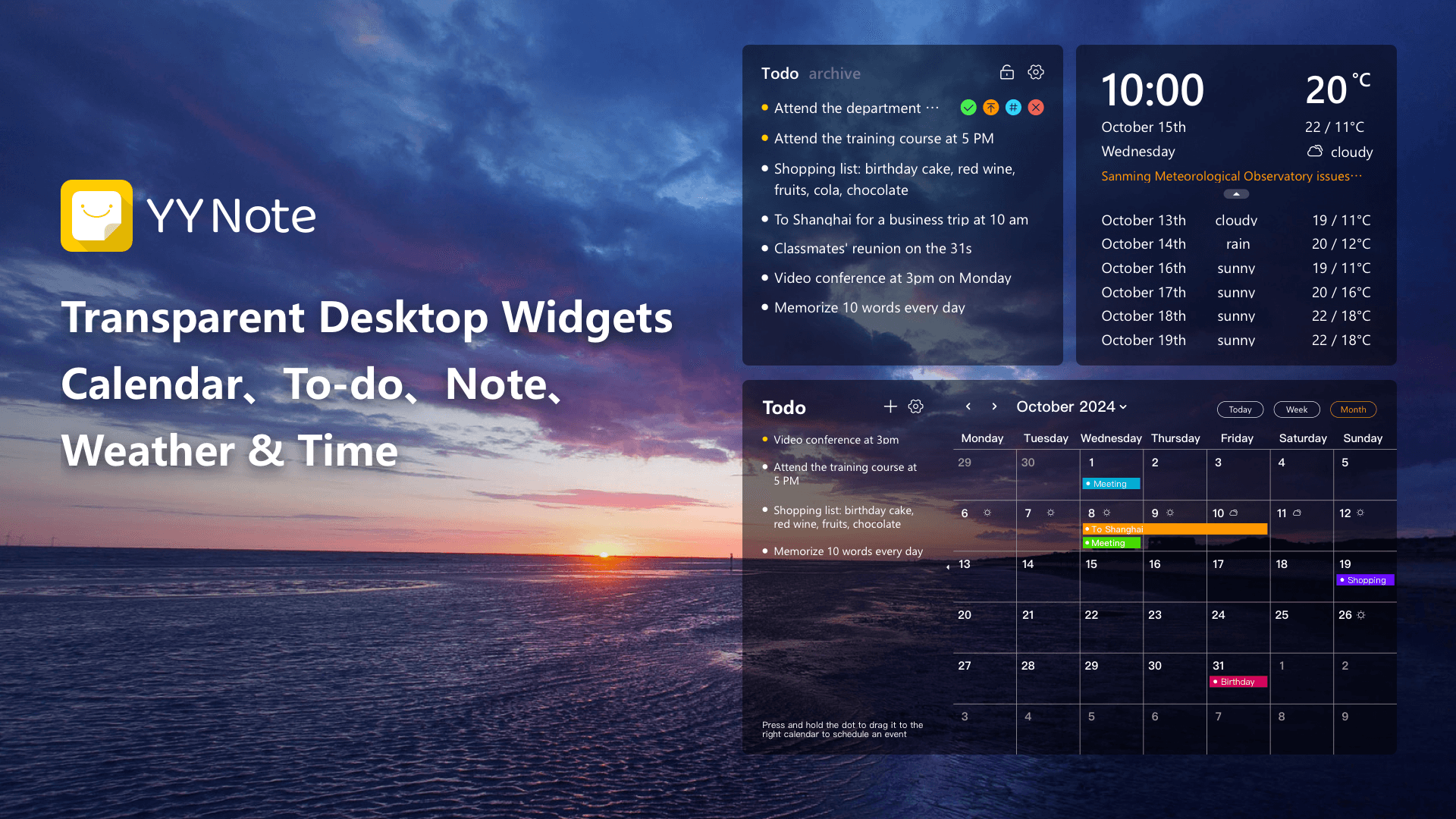
To prevent this inefficient cycle of "plans not keeping up with changes", your desktop may need a more intuitive and powerful hub. Having such a desktop calendar that can be deeply integrated with your to-do list is the key to improving your ability to control your schedule.
Say goodbye to siled islands and make schedules and tasks clear at a glance
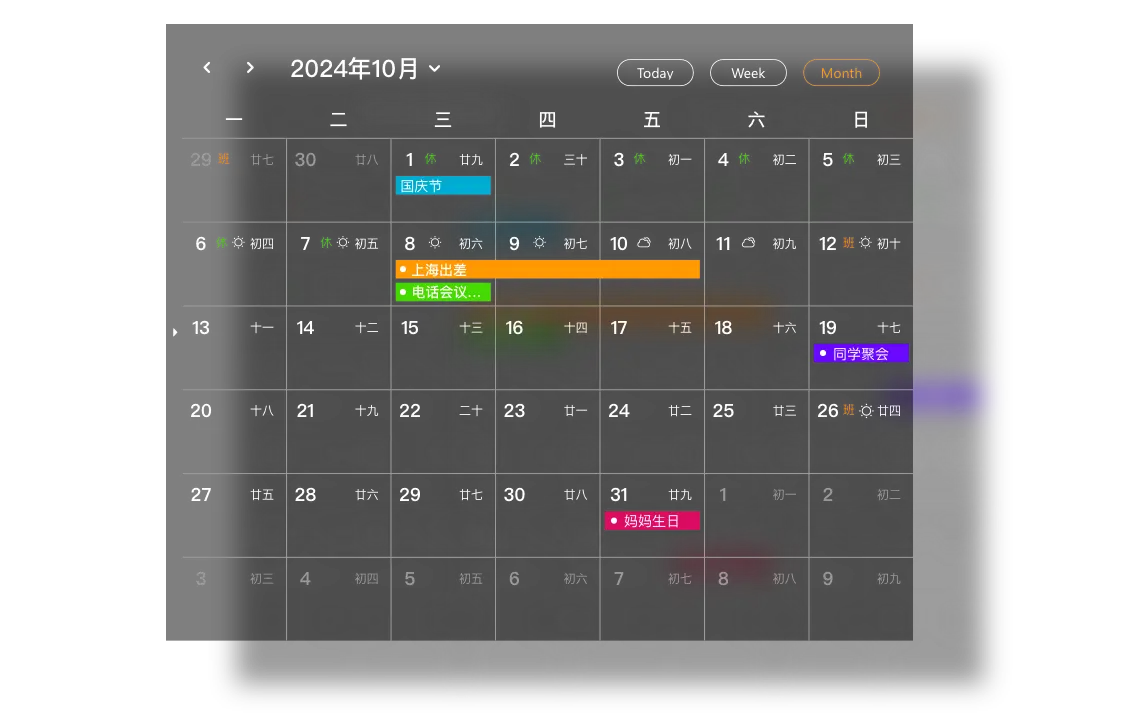
In the past, traditional schedule management tools often separated the calendar and to-do items. The calendar only controlled the time point, and the to-do items only focused on what needs to be done. There is no way to achieve linkage between the two. Imagine that you just treat a to-do task like scheduling a meeting, and it can be done directly. Just drag the mouse to a specific date or time block in the calendar, and a clear schedule plan will be achieved instantly. This "drag-and-schedule" method eliminates the need for repeated application switching, copying and pasting, and reduces the time cost of planning to a minimum. You can fully grasp the key nodes of major events every month and every week. In the "day view" of every day, you can accurately and properly arrange each task according to "when to do it" and "what to do" and complete it in one step.
Connect fragments in series and plan your time "industry chain"
Splitting a complex task into multiple steps is a good way to improve execution efficiency. However, if this "industrial chain" is scattered in different places, it will easily become disconnected. An excellent desktop calendar allows you to set flexible time periods and deadlines for tasks, and form a clear timeline. For example, a "project report" task is broken down into "data collection, PPT production, and rehearsal", and each is arranged to be completed within three days. The calendar view is like an adhesive, connecting these "point"-shaped steps into clear execution "lines" to ensure that every step you take is on the correct rhythm. Whenever the weekly review time comes, this completed time map is an extremely intuitive proof of the effectiveness of your work.

Create your own efficient desktop ecosystem
A truly high-quality tool, the to-do calendar, should be as natural as breathing, and then become a part of the efficient work environment you create. It can be fully integrated into your computer desktop, without blocking your wallpaper and files, and transform into a translucent state that is always in standby mode. The "second screen", whether it is the key points of work that must be checked every day, or the important meeting content that has been synchronized, it can completely present it and effectively make it visible after turning on the phone, without having to bother to find it at all.
This kind of integration and the sense of control brought by convenience can not only help you clearly arrange 24 hours a day, but also save you a lot of "thinking connection" costs caused by confusion and forgetfulness, giving you extra time to think about really important things and achieve an orderly balance between work and life. Now, try to use the desktop as your most efficient office area, and experience the ease of having all your schedules and tasks under control.
Download Now → Unlock Desktop Efficiency Center:

Microsoft Store

Google Play

App Store